
When Multi-Stage Systems Outperform Streamlined? DIY Detailing Scenarios
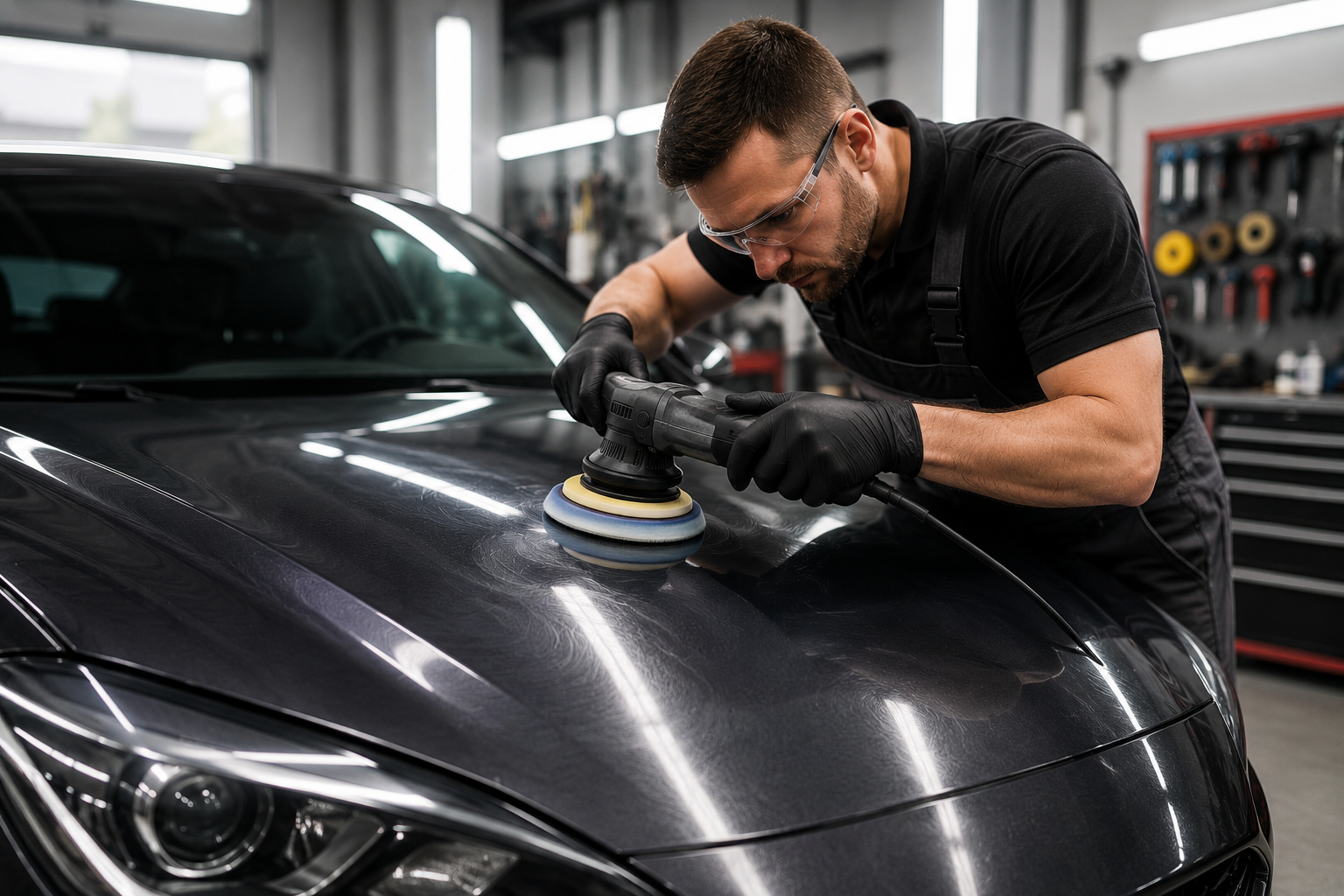
You’ve probably seen those “one-step” polishes promising professional results in half the time. But if you’re working on black paint or dealing with deep swirl marks, there’s a good chance you’re about to waste an entire afternoon chasing defects that keep reappearing under sunlight.
Key Takeaways
- Multi-stage paint correction outperforms one-step polishing when defects are deep, widespread, or involve severe oxidation and water spot etching.
- Dark-coloured vehicles – especially black – almost always benefit from at least a two-stage approach, as single-step products can leave deeper flaws visible under natural light.
- Products like 3M Perfect-It are built around a staged system for a reason: each phase targets a different layer of damage, giving you precise control that one-step products simply cannot replicate.
- A dual-action (DA) polisher is the recommended starting point for DIY detailers tackling multi-stage correction – safer than a rotary and far more effective than hand polishing.
- Understanding exactly when and why multi-stage correction earns its place – covered in detail below – could save your paintwork from irreversible over-correction or an underwhelming finish.
There’s a tempting logic to one-step polishing: one product, one pad, job done. For light swirls and minor haze, that logic holds up. But paint defects aren’t always polite enough to stay shallow, and when they aren’t, a streamlined approach can leave you staring at the same scratches you started with – only shinier.
One-Step Polish Can’t Fix Everything
Single-stage correction removes light defects: mild swirl marks, faint water spots, minor haze from poor washing habits. That’s a genuinely useful capability, and for a well-maintained car getting a refresh, it’s often all that’s needed.
The problem starts when defects go deeper. Heavy swirl patterns, random intermittent deep scratches (RIDS), severe water spot etching, and oxidised paint all sit beyond what a one-step product’s abrasive technology is designed to reach. Attempting to correct these with a single polish typically results in partial removal – the defect looks better under artificial workshop lighting but reappears under direct sunlight or at certain angles.
That gap between what one-step products promise and what they can actually deliver on neglected or heavily marked paint is precisely where multi-stage correction earns its place. IPS Paint’s professional paint correction range covers the full spectrum of staged correction products for DIY detailers who want workshop-quality results at home.
What Multi-Stage Correction Actually Does
The Layered Approach Explained
Multi-stage paint correction breaks the process into dedicated phases, each targeting a specific level of damage. A typical two-stage system uses a heavy-cut compound to remove the bulk of defects – deep swirls, scratches, water spot etching – followed by a lighter polish to refine the surface and eliminate any haze or marring left by the first stage.
Three-stage correction adds an additional step upfront, often an ultra-heavy compound or wet-sanding, reserved for the most severe cases: heavily oxidised paint, deep scratches that stop just short of the base coat, or coarse sanding marks from body repair work.
Why Each Stage Matters
Each stage has a distinct job, and skipping one typically compromises the result. The cutting stage removes the defect. The polishing stage removes the micro-scratches left by cutting. The finishing stage maximises optical clarity and depth – particularly important on darker colours where any remaining haze reads as dullness rather than shine.
Attempting to perform all three roles with one product means accepting a compromise at every stage. A product aggressive enough to cut deep defects will rarely leave a finish clean enough to call complete, and a product refined enough to leave a flawless gloss rarely carries the abrasive power to remove serious damage.
Defects That Demand Multi-Stage
Deep Scratches & Heavy Swirling
RIDS – random intermittent deep scratches – are among the most common reasons DIY detailers find themselves frustrated after a one-step correction. These scratches typically come from improper washing technique, drive-through car washes, or careless handling. They’re irregular, inconsistent in depth, and often only fully visible under direct, raking light.
Heavy swirl patterns from repeated incorrect machine polishing or coarse wash equipment behave similarly. A one-step polish may reduce their appearance in photos, but under natural light or a paint inspection lamp, the depth remains. A dedicated cutting compound on a heavier foam pad, followed by a refining stage, removes the material around the scratch uniformly – levelling the surface rather than merely blurring the edges of it.
Severe Water Spot Etching & Oxidation
Water spot etching occurs when mineral deposits bond to the clear coat and etch into the surface over time. Light spots respond to one-step polishing. Severe etching – from prolonged exposure or hard water sources – physically damages the clear coat structure and requires aggressive abrasive work to level the surface properly.
Oxidation presents a similar challenge. Paint left unprotected and exposed to UV for extended periods becomes chalky, dull, and rough to the touch. This level of surface degradation requires a heavy-cut first stage, and often a full three-stage process, to restore any meaningful gloss and clarity.
Dark Paint Is a Different Problem
Black, dark navy, graphite – these colours are unforgiving in a way that lighter shades simply aren’t. Every swirl mark, every micro-scratch, every trace of haze shows up under sunlight on a dark finish. A white or silver car might look acceptable after a single-stage correction; the same level of correction on a black car will often reveal remaining defects that weren’t visible under interior lighting.
Expert consensus in the detailing world is consistent on this point: on darker colours, a two-stage correction is almost always the recommended approach if budget and time allow. The first stage removes the defects. The second stage refines away anything the cut left behind, producing the depth and clarity that make a dark finish genuinely impressive rather than merely clean.
Softer clear coats are more susceptible to hologramming from aggressive pads, which means the refining stage isn’t optional – it’s a necessary part of achieving a clean result.
Multi-Stage vs. One-Step: Sanding Marks & Refinement
3M Perfect-It for Controlled Multi-Stage Refinement
The 3M Perfect-It system is built around the principle that each stage of correction deserves its own dedicated product. The Fast Cut Plus Extreme (Green Cap) handles heavy defect removal and sanding marks up to P1500-P2000 grit. The Extra Fine Plus Compound (Yellow Cap) refines the surface after cutting, removing swirl marks and preparing for a final finish. The Ultrafine Machine Polish (Blue Cap) eliminates holograms and maximises optical gloss.
For a DIY detailer dealing with sanding marks from a body shop repair or tackling serious swirling on a neglected vehicle, this structured workflow gives real control – each step can be assessed and repeated independently without affecting the others. That’s a meaningful advantage when the stakes are high and the paint is expensive.
Sonax Cut & Finish for Moderate Defects Up to P1500
Sonax PROFILINE Cut+Finish sits at the opposite end of the philosophy – combining moderate cutting power with finishing abrasives in a single product. It handles sanding marks up to approximately P1500 grit and removes swirl marks, light oxidation, and holograms in one polishing stage. For a vehicle with moderate defects, this is a genuinely efficient solution.
Its limitation is clearly defined: it isn’t designed for heavy correction. For severe defects, the Sonax system steps up to PROFILINE Ultimate Cut 6+ as an aggressive first stage, with Cut+Finish and PROFILINE Perfect Finish following as refinement steps – essentially replicating the multi-stage structure by necessity. Even within Sonax’s own system, severe defects pull the process back towards a multi-stage workflow.
DIY Reality: Skill, Time & Equipment
Multi-stage correction takes longer, uses more product, and demands more from the operator. On a typical saloon with moderate-to-heavy defects, a proper two-stage correction with machine polishing can take the better part of a full day. A three-stage process on a severely neglected vehicle can stretch further still.
The results, however, are proportionally dramatic. Deep swirl marks, oxidation, etching, and scratches that have accumulated over years of neglect can be eliminated, restoring a finish that looks genuinely showroom-fresh rather than merely improved.
DA Polisher vs. Rotary for Multi-Stage Work
For beginners and intermediate DIY detailers, a dual-action (DA) polisher is the right tool for multi-stage work. The random orbital motion significantly reduces the risk of burning through thin clear coat – a very real danger when using a cutting compound with a rotary in inexperienced hands. A DA allows more aggressive compounds to be used with a meaningful safety margin, making the multi-stage process accessible without requiring years of professional experience.
Rotary polishers offer more cutting power and are favoured in professional environments for speed and efficiency, but the margin for error is narrow. For DIY multi-stage correction, a quality DA polisher paired with the right compound and pad selection delivers excellent results without the risk.
Multi-Stage Results Justify the Extra Effort for Severe Defects
The case for multi-stage correction isn’t about complexity for its own sake. The process should match the severity of the problem. For well-maintained paint with light defects, one-step polishing is efficient and effective. For dark colours, neglected finishes, heavy swirling, or paint coming off a body repair, a single product simply doesn’t have the range to do the job properly.
Multi-stage correction – done with the right compounds, the right pads, and a DA polisher – produces results that are genuinely difficult to argue with: defect-free paint with clarity and depth that holds up under any lighting condition. The extra time and effort involved aren’t drawbacks; they’re the mechanism by which serious defects get properly resolved rather than partially masked.
For professional-grade paint correction products, polishing systems, and detailing supplies, IPS Paint supplies body shops and automotive detailers across South Wales with everything needed to achieve durable, high-quality results at every stage of the correction process.