
Roar 1030 vs CQuartz: Paint Correction Polish or Ceramic Coating?
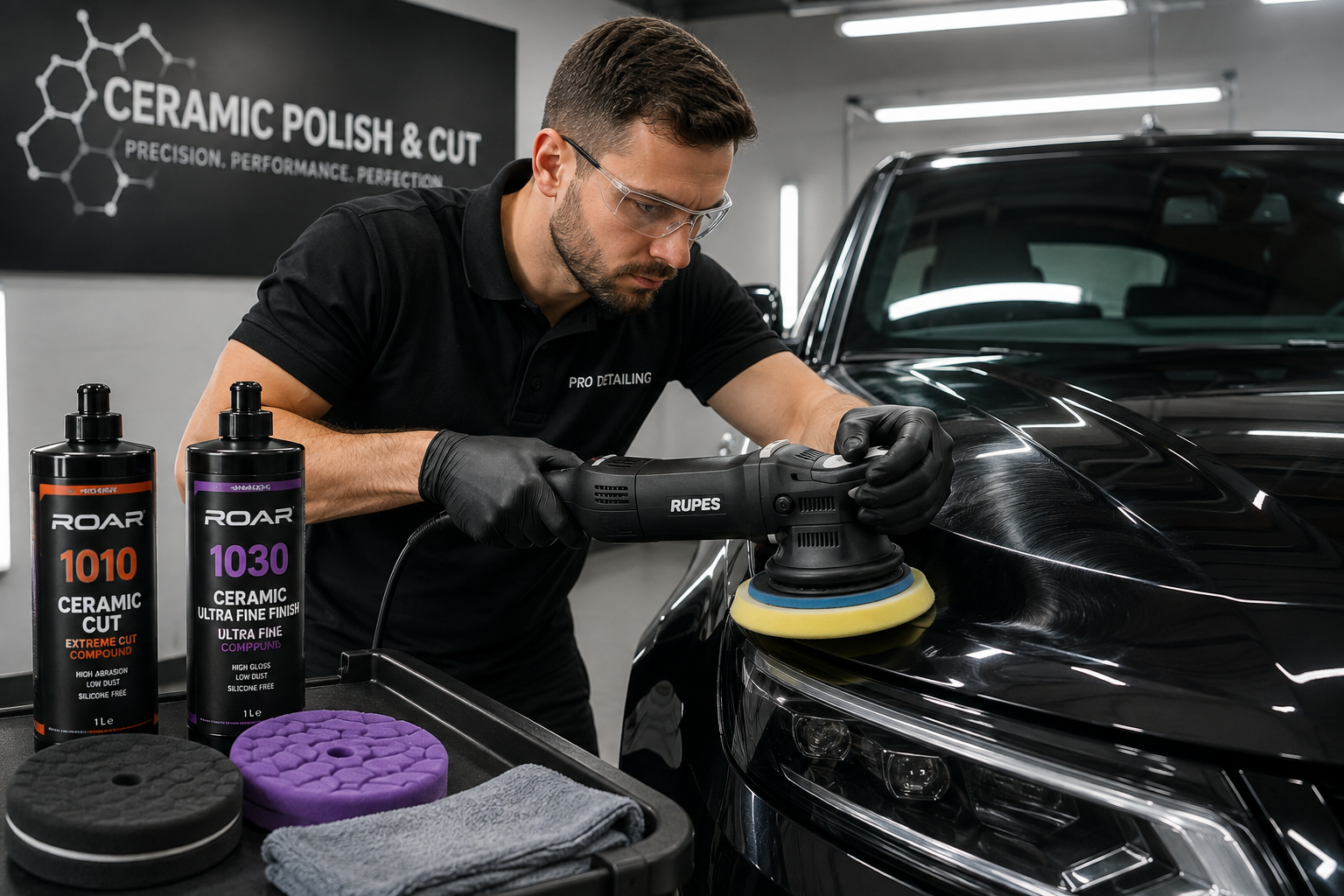
Think all “ceramic” products do the same job? One removes swirl marks and holograms, the other locks in protection for up to two years – confuse them and you could seal defects into your paint permanently. Here’s the correct order to avoid costly mistakes.
Key Takeaways
- ROAR 1030 Ceramic Ultra Finish Polish and CARPRO CQUARTZ solve different problems: one refines the paint surface, the other protects it once refined
- The word ‘ceramic’ in ROAR 1030’s name refers to the sub-micron abrasives used in polishing, not to a protective coating layer
- CARPRO CQUARTZ UK 3.0 provides a real-world durability claim of 18-24 months once applied to properly corrected paint
- Coating over swirl marks and holograms without correcting them first can seal defects in rather than hide them, so the order of operations matters
- Darker paint colours often show the most benefit from a final refinement stage before any ceramic coating goes on
Ask a detailer what “ceramic” means on a product label and the answer might surprise. Some ceramic products cut and polish paint, while others coat and protect it, and mixing the two up can lead to disappointing results on an otherwise well-prepared vehicle.
Two Products, Two Different Jobs
ROAR 1030 Ceramic Ultra Finish Polish and CARPRO CQUARTZ often turn up in the same search results, but they belong to different stages of a detailing job. ROAR 1030 is built for the final polishing steps, refining paint until swirl marks, fine scratches and holograms disappear under inspection lighting. CQUARTZ, by contrast, is a ceramic coating range designed to sit on top of that corrected surface and protect it for the long haul.
Detailers who understand this split waste less time and product. Rather than asking which one is the “better” ceramic option, a more useful question is how correction and protection work together across a job. For technicians researching the wider ROAR range alongside coatings, ROAR products and detailing supplies are worth a look when planning a full correction-to-protection workflow.
Getting the sequence right matters more than picking a single standout product, because each one is doing a job the other cannot replace.
What Ultra-Fine Finish Polish Actually Does
ROAR 1030 is an ultra-fine finishing product, meant for the closing stages of professional paint correction rather than heavy defect removal. It uses sub-micron ceramic abrasives to break down and eliminate the very fine scratches, swirl marks and holograms that survive earlier, heavier compounding stages. On a bonnet that’s already had the deep marks cut back, ROAR 1030 pushes the finish to genuine mirror clarity.
It works across a range of paint systems, including UHS (Ultra High Solid) and SR (Scratch Resistant) finishes, making it a flexible choice regardless of the vehicle’s original coating type. Technicians also find it easy to apply and remove, which matters when working through multiple panels on a tight turnaround. The goal at this stage isn’t gloss for its own sake; it’s perfecting the mechanical surface before anything else touches it.
Why ‘Ceramic’ Refers to the Abrasives, Not a Coating
Confusion often creeps in simply because “ceramic” appears in the product name. In ROAR 1030’s case, ceramic describes the abrasive technology inside the polish, not a protective film left behind afterwards. These ceramic abrasives are known for a microcrystalline structure that self-sharpens as it works, helping remove material efficiently without leaving new marring behind.
That distinction has a practical upside for body shops. ROAR 1030 contains no fillers, silicones or waxes, which keeps it body-shop safe and lets a technician see the genuine, unmasked condition of the corrected paint. Fillers can temporarily hide swirl marks and give a false impression of a flawless finish, so a filler-free polish gives an honest read of the paintwork before any coating decision is made.
What Ceramic Coatings Are Built For
CQUARTZ approaches the job from the opposite direction. Instead of an abrasive finishing product, it’s a coating designed to sit on top of paint that’s already been corrected, forming a protective and hydrophobic layer. CARPRO structures its wider system around preparation, protection and maintenance stages, with polishing sitting in preparation and CQUARTZ coatings occupying the protection stage.
CQUARTZ UK 3.0, for example, is CARPRO’s consumer-grade coating built for chemical and environmental resistance alongside a high-gloss finish, with a silicon dioxide content around 70%. For professional applications, CARPRO also offers CQUARTZ Professional, aimed at enhanced protection with strong hydrophobic and oleophobic behaviour. There’s also CQUARTZ SiC, which incorporates silicon carbide for extra chemical resistance, water-spot resistance, smoothness and gloss, and CQUARTZ Lite 2.0, an easier-to-apply entry point with strong beading performance.
How Long Protection Really Lasts
Durability claims vary across the CQUARTZ range, and it’s worth knowing the numbers rather than assuming all ceramic coatings perform the same way. CQUARTZ UK 3.0 carries a real-world durability claim of 18-24 months, resistant to chemicals across an approximate pH range of 3 to 14. CQUARTZ Lite 2.0 offers up to 2 years of durability with strong hydrophobic properties for those wanting an easier application process.
Actual longevity depends on more than the product itself. Application quality, environmental exposure and ongoing maintenance all play a part in how long a coating keeps performing at its best, which is why proper surface preparation before application matters as much as the coating chosen.
Why Coating Over Defects Backfires
It’s tempting to reach for a coating straight away when a vehicle needs both gloss and protection fast. Applying a ceramic coating directly over swirl marks or holograms can make the paint look glossier at first glance, but it doesn’t mechanically remove those imperfections. The defects are still there underneath, and a hard, durable coating can make them considerably harder to correct afterwards without stripping the coating first.
Picture a black vehicle arriving covered in fine washing swirls and light holograms. Coating over that finish locks the flaws in for the life of the coating, which on CQUARTZ UK 3.0 could mean living with visible marring for close to two years. Correcting the paint first, then coating it, avoids that trade-off entirely and gives the finished result far more staying power.
Correct, Refine, Protect: The Right Order
A dependable professional workflow follows a clear sequence: wash, decontaminate, inspect, correct, refine, prepare, protect. ROAR 1030 sits at the end of the correction stage, while CQUARTZ sits at the very start of the protection stage that follows. Heavier compounding handles deeper scratches, oxidation or sanding marks first, and ROAR 1030 is then introduced to finish off the fine imperfections that stop paint from reaching maximum clarity.
Once polishing is complete, residue and polishing oils need removing, and the surface should be prepared according to the coating manufacturer’s instructions before any CQUARTZ product goes on. Skipping that preparation step, even after correction, can compromise how well the coating bonds and how long it lasts.
Where Dark Paint Needs Extra Refinement
Dark colours are unforgiving in a way lighter paint simply isn’t. Holograms and micro-marring that go unnoticed on silver paint become glaringly obvious on a black bonnet under direct sunlight or inspection lighting. This is exactly why ROAR 1030 suits darker colours especially well, where an optically refined finish makes the biggest visible difference.
For prestige or high-value vehicles heading for a ceramic coating, this final refinement stage carries real weight. The better the paint looks going into the coating process, the better the finished ceramic treatment looks once it’s applied.
Choosing Protection Once Correction Is Done
Once the paint has reached the required standard, the priority shifts from removing defects to preserving what’s been achieved. This is where the specific CQUARTZ product matters. Detailers weighing up options might consider:
- CQUARTZ UK 3.0 for chemical resistance, high gloss and an 18-24 month real-world durability claim
- CQUARTZ Professional for enhanced hydrophobic and oleophobic performance on professionally prepared vehicles
- CQUARTZ SiC for extra chemical and water-spot resistance thanks to its silicon carbide content
- CQUARTZ Lite 2.0 for an easier application process and up to two years of protection
Matching the coating to the vehicle and customer’s expectations, rather than defaulting to one product for every job, tends to produce more consistent long-term results.
Can You Skip a Step?
Not every vehicle needs the full sequence, and understanding when a step can be skipped saves both time and product.
Using the Polish Without a Coating
ROAR 1030 doesn’t dictate what happens after it. Because it leaves no fillers, waxes or silicones behind, a technician remains free to choose wax, sealant or a ceramic coating afterwards, based on what the vehicle and customer actually need. A body shop might only need a high-quality corrected finish with no coating at all, while another customer might want a straightforward sealant. That flexibility keeps the correction decision separate from the protection decision, a genuine advantage when working across varied customer requests.
Coating Without Prior Correction
CQUARTZ can go straight onto paint that’s already in excellent condition. A nearly new vehicle with minimal swirling might only need a wash, decontamination and appropriate surface preparation before coating. However, once visible swirl marks or holograms are present, correcting them first will almost always produce a noticeably better result once the coating is applied. The condition of the paint on arrival, rather than a fixed rule, should determine how much correction work is genuinely necessary.
Correction and Protection Aren’t Competing Choices
ROAR 1030 Ceramic Ultra Finish Polish and CARPRO CQUARTZ answer different questions entirely. One asks how close to perfect the paint surface can get; the other asks how long that perfection can be preserved. Treating them as competing products misses the point of what each was built to do.
For technicians planning a job that needs both outstanding clarity and lasting protection, the practical answer is straightforward: correct and refine the paint first, then choose the coating that matches the vehicle’s needs. Getting familiar with a paint correction and ceramic coating range that covers both stages makes it easier to move from refinement to protection without switching suppliers mid-job.