
Roar 1020 vs Gtechniq Crystal Serum: Correction Then Protection Stages
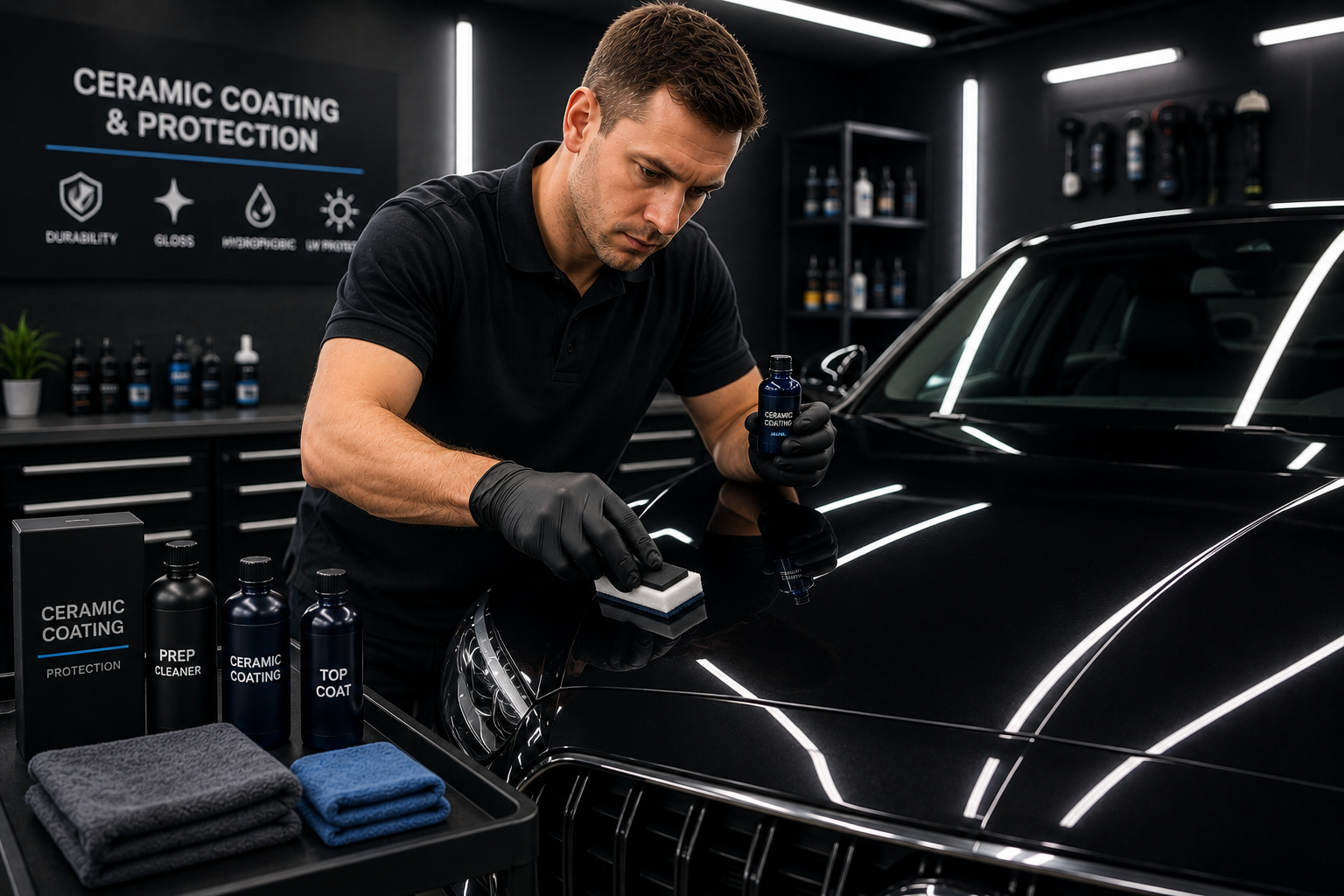
Most detailers misunderstand the difference between paint correction compounds and ceramic coatings, often applying protection over uncorrected swirls and defects. Here’s why that permanently seals in problems, and which product actually belongs in each stage of your workflow.
Key Takeaways
- ROAR 1020 Ceramic Finish is a paint correction compound – it removes swirl marks and refines paint, but it is not a ceramic coating.
- Gtechniq Crystal Serum (Light and Ultra) is a genuine ceramic protective coating – it preserves and enhances paint that has already been properly prepared.
- Applying a ceramic coating over uncorrected paint permanently seals in defects – correction always comes first.
- The two products are not rivals; they belong to sequential stages of a professional detailing workflow.
- Understanding the difference between mechanical gloss improvement and protective-layer gloss is where most misconceptions begin – and that is covered in detail below.
Two products. Two very different jobs. The confusion usually starts with the word “ceramic” appearing in both names – but that single shared term masks a fundamental difference in purpose that every professional detailer and body shop should understand clearly.
Two Different Jobs, Not Two Rivals
ROAR 1020 Ceramic Finish and Gtechniq Crystal Serum are not competing products. Positioning them as alternatives is a category error – like comparing a primer to a topcoat and asking which is better.
ROAR 1020 is a finishing compound. Its job is to correct paint: removing swirl marks, refining the clear coat, and producing a high-gloss surface ready for the next stage. Gtechniq Crystal Serum is a ceramic protection system. Its job is to preserve and enhance a surface that has already been correctly prepared. One product creates the foundation; the other protects it. IPS Paint supplies both product categories and regularly fields questions from professional detailers who want clarity on exactly this distinction.
The clearest way to frame it: ROAR 1020 belongs before the coating stage. Crystal Serum belongs after it.
What ROAR 1020 Actually Does
ROAR 1020 is designed for the finishing stages of machine paint correction. The manufacturer specifies it as permanently removing swirl marks, enhancing gloss, and producing a showroom finish – suitable for modern paint systems, including scratch-resistant ones. ROAR recommends pairing it with their 6-inch Waffle Black Foam Pad (620PF) for best results.
Consider a dark-coloured bonnet after an initial heavier correction stage. The obvious defects are gone, but under proper inspection lighting there may still be compounding haze, fine swirl marks, micro-marring, and reduced clarity. ROAR 1020 addresses exactly that residual finishing work – refining the surface until the reflection is clean and sharp.
Swirl Removal, Not Coating
Paint correction works by physically abrading a microscopic layer of clear coat to level out light-scattering defects. ROAR 1020 achieves this through corrective abrasives in its formulation. Once those defects are genuinely removed by mechanical refinement, they do not simply reappear when a product wears off – new swirls develop only when the paint receives new damage. That is a fundamentally different kind of durability from what a ceramic coating offers, and the two should never be conflated.
Why Silicone-Free Matters in a Body Shop
ROAR 1020 is formulated to be silicone-free and body-shop safe. In a professional refinishing environment, silicone contamination is a serious problem – it can cause adhesion failures in fresh paint and create fisheye defects. A finishing compound that introduces silicone into a spray booth environment is not usable in those conditions. ROAR 1020’s silicone-free formulation makes it a practical working product for body shops, not just a detailing-studio option.
What Crystal Serum Protects
Gtechniq Crystal Serum does not polish anything out of the paint. It creates a ceramic protective layer over a properly prepared surface – bonding with the clear coat and providing resistance against environmental contaminants, chemicals, UV exposure, bird droppings, water spotting, and future micro-marring. Gloss is enhanced through the protective layer itself, not through mechanical refinement.
Crystal Serum Light: Up to Five Years of Durability
Crystal Serum Light (CSL) is a silicon-dioxide-based ceramic coating designed for both professional detailers and enthusiasts. Gtechniq describes it as providing up to five years of protection when correctly applied and maintained, with strong gloss, chemical resistance, and swirl resistance. Crucially, if an application error occurs, Crystal Serum Light can be machine polished off – an important practical consideration for anyone applying it without accreditation.
Crystal Serum Ultra: Nine-Year Professional Guarantee
Crystal Serum Ultra (CSU) is Gtechniq’s flagship professional coating, restricted to trained, accredited installers. Its composite two-layer structure – a harder upper layer combined with a more flexible base – is rated at 10H hardness and carries a nine-year guarantee under Gtechniq’s programme when professionally applied and maintained. That level of chemical and abrasion resistance is simply not achievable with a finishing compound, and it is not meant to be. CSU is the end of the detailing process. Incorrectly applied Crystal Serum Ultra is resistant enough that wet sanding may be required for removal – one practical reason accreditation matters here.
Why Correction Must Come First
A ceramic coating bonds with and over the surface it is applied to. Whatever condition the paint is in at that moment becomes permanently preserved beneath a highly durable layer. Swirl marks, compounding haze, holograms – a coating does not hide them. Under direct lighting, those defects remain visible, now sealed in place under protection that may last the better part of a decade.
Gtechniq’s own professional installation guidance highlights paint correction as a critical preparation step before Crystal Serum application. Accredited detailers consistently describe a clinical process: decontamination, paint correction to remove swirl marks, a panel wipe to strip polishing oils, and only then the coating. There is no shortcut that replaces that sequence and delivers a comparable result.
Gloss: Mechanical Refinement vs Protective Layer
Both ROAR 1020 and Gtechniq Crystal Serum enhance gloss – but through completely different mechanisms, and understanding the difference matters.
ROAR 1020 achieves gloss by physically removing the defects that scatter and break up reflected light. Swirls and micro-marring cause reflections to look dull, hazy, or confused. When those defects are corrected, reflected light becomes clean and coherent – increasing clarity, depth, and perceived gloss. The improvement is a direct result of the improved surface geometry of the clear coat itself.
Crystal Serum achieves gloss by adding a high-gloss protective ceramic layer over the prepared paint. Gtechniq highlights increased gloss and depth as a key benefit of both CSL and CSU. That layer is applied over whatever surface exists underneath – which is why the quality of the corrected paint beneath it remains the defining factor in the final result. Used correctly in sequence, both processes contribute to gloss in ways that build on each other.
The Professional Workflow
For any professional offering a ceramic coating package, the workflow is not a choice between correction and protection – it is both, in the right order.
Decontaminate and Inspect
Before any polishing begins, the vehicle needs a thorough wash followed by decontamination to remove bonded surface contamination. After that, proper inspection under a focused light source identifies exactly what needs correcting: scratches, swirls, oxidation, holograms, or compounding haze. Inspection determines whether heavier multi-stage correction is needed before a finishing pass, or whether the paint is refined enough to move straight to ROAR 1020.
Correct with ROAR 1020, Then Coat with Crystal Serum
Once heavier correction work is complete where required, ROAR 1020 handles the finishing stage – eliminating remaining swirls, haze, or micro-marring and bringing the paint to a clean, high-gloss surface. After that, polishing oils and residues are removed according to Gtechniq’s surface preparation requirements before Crystal Serum is applied.
The choice between Crystal Serum Light and Crystal Serum Ultra at that point comes down to client expectations and installer accreditation. For the longest-duration professional guarantee, CSU is the answer. For a highly capable, more accessible option – or where a client wants a coating that can be corrected off if necessary – CSL covers the brief effectively.
Perfect the Paint First. Protect It Second.
The professional standard is straightforward once the two stages are clearly separated. Correction removes what should not be there. Protection preserves what should. ROAR 1020 handles the first part – permanently removing swirl marks and bringing the paint to a showroom-quality finish, with a silicone-free formulation suited to body shop environments. Gtechniq Crystal Serum handles the second part – locking in that quality with up to five years of ceramic protection through Crystal Serum Light, or a nine-year professional guarantee through Crystal Serum Ultra.
The products belong together in a workflow, not against each other in a comparison. The question is never which one to use – it is making sure neither stage is skipped.
For professional-grade correction compounds, ceramic coatings, and detailing supplies, IPS Paint stocks the products and expertise that body shops and detailers rely on.