
Roar 1020 vs Chemical Guys: South Wales Supplier on Correction vs Protection
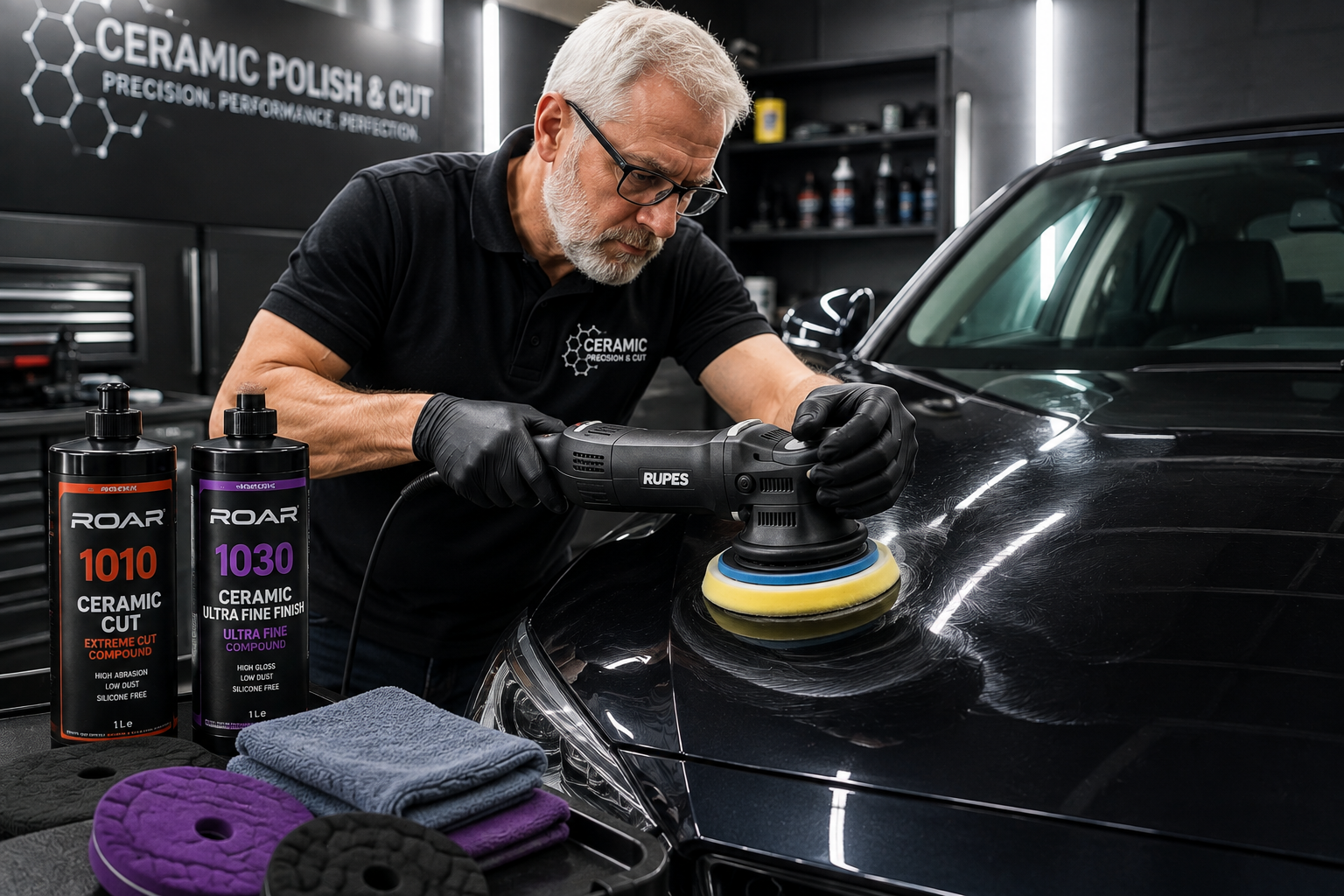
Both products have “ceramic” on the label, but one removes swirl marks while the other just locks them in. Professional detailers know the difference matters, but here’s why choosing the wrong product at the wrong stage ruins an otherwise perfect paint job.
Key Takeaways
- Roar 1020 Ceramic Finish is a paint correction compound – it physically removes swirl marks and polishing defects using ceramic abrasive technology. It is not a protective coating.
- Chemical Guys HydroSlick is a SiO₂ ceramic protection product – it enhances gloss and provides hydrophobic protection on an already-corrected surface.
- The word “ceramic” appears on both labels, but the two products serve fundamentally different stages of the detailing process – which is exactly where the confusion begins.
- Used in sequence – correction first, protection second – these two products can actually complement each other rather than compete.
- IPS Paint, based in South Wales, supplies Roar’s professional polishing system and offers hands-on product knowledge for body shops and detailers navigating decisions like this one.
The detailing industry has a terminology problem. Two products can carry the word “ceramic” on the label and have almost nothing in common in terms of what they actually do to paint. That gap matters most to professionals who need to make the right call on every vehicle that leaves the workshop.
Two ‘Ceramic’ Products, Two Completely Different Jobs
Both Roar 1020 Ceramic Finish and Chemical Guys HydroSlick Intense Gloss SiO₂ Ceramic Coating HyperWax have “ceramic” front and centre in their branding. That shared language makes a direct comparison feel logical. In practice, these products sit at opposite ends of the detailing process.
Roar 1020 is a finishing compound. It uses ceramic abrasive technology to physically refine the paint surface – cutting away swirl marks, light scratches and polishing haze to leave a high-clarity, high-gloss finish. Chemical Guys HydroSlick is a ceramic protection product. It applies to a surface that has already been corrected and prepared, forming a SiO₂-based layer that enhances gloss, repels water and shields the paint from environmental contamination.
One product changes the paint. The other protects it. That distinction is the foundation of any professional detailing workflow – and the kind of practical clarity that IPS Paint brings to body shops and detailing businesses across South Wales.
What Roar 1020 Actually Does
Roar 1020 Ceramic Finish is the second stage in Roar’s Ceramic Polishing System. Its job is to take paint that has already gone through a cutting stage and refine it – removing fine swirls, light holograms and polishing marks that heavier compounds leave behind, while simultaneously building gloss.
Roar describes 1020 as permanently removing swirl marks. That word – permanently – carries real weight in professional detailing. The product does not fill or mask defects with oils or fillers. It physically abrades the clear coat to a finer, more optically consistent surface. The result holds until new damage is introduced.
Application is by machine polisher, with Roar’s 6-inch Waffle Black Foam Pad as the recommended pad. It is compatible with modern paint systems, including scratch-resistant clear coats – a specification that matters increasingly as OEM finishes evolve.
Ceramic Abrasives, Not a Ceramic Coating
The ceramic technology in Roar 1020 refers to the abrasive particles used in the compound’s formulation – not to any protective layer left on the surface after polishing. Once the compound is wiped away, no ceramic film remains. The benefit is a corrected surface, not a coated one. This is a critical distinction that is easy to miss when browsing product names without reading further.
Why Silicone-Free Matters in a Body Shop
Roar 1020 is formulated to be silicone-free and body-shop safe. In refinishing environments, silicone contamination is a serious concern – even trace amounts left on a panel can cause fisheyes and adhesion failures in subsequent paint applications. A silicone-free finishing compound can be used as part of an active body-shop workflow without putting repair work at risk. For a professional shop, that is non-negotiable.
What Chemical Guys HydroSlick Actually Does
Chemical Guys positions HydroSlick as a true ceramic coating in an accessible gel format – one that applies similarly to a traditional wax but delivers SiO₂-based protection. It is designed to be applied to a clean, cool and dry surface using an applicator pad, then buffed off with a microfibre towel after a short dwell time.
SiO₂ Protection, Not Correction
HydroSlick bonds to the paint surface and forms a protective layer claimed to last up to 12 months. It increases colour depth and reflectivity, creates a hydrophobic surface that repels water and contamination, and offers UV resistance. Chemical Guys states that swirls and scratches should be corrected by machine polishing before HydroSlick is applied. The product enhances a prepared surface – it cannot substitute for correction on a damaged one.
Head-to-Head: Correction, Gloss and Durability
Paint Correction: Clear Winner
Winner: Roar 1020 Ceramic Finish. If paint has visible swirls, haze or polishing marks, Roar 1020 is the only appropriate product of these two. HydroSlick contains no abrasive capability. Applying a ceramic coating over defects does not remove them – it locks them in under a glossy layer, which is the opposite of a professional finish.
Gloss: Two Different Routes to the Same Goal
Result: Both – but through different mechanisms. Roar 1020 creates gloss by refining the paint itself. Swirl marks and microscopic surface texture scatter light, reducing clarity. Remove those defects and the paint reflects more cleanly. HydroSlick adds gloss differently – by applying a ceramic layer that increases depth, slickness and reflectivity on top of an already-smooth surface. Neither approach is wrong. They are sequential, not competing.
Durability: Depends Which Type You Mean
There are two distinct definitions of durability at work here, and conflating them leads to poor product decisions.
- Roar 1020 durability: The correction is permanent until new defects are introduced. A swirl that has been abraded away does not return on its own.
- Chemical Guys HydroSlick durability: The protective SiO₂ layer is claimed to last up to 12 months, providing ongoing hydrophobic performance and contamination resistance during that period.
The detailing industry broadly recognises that combining thorough paint correction with a subsequent ceramic coating produces superior long-term gloss and protection compared to a single one-step product approach. The reason is straightforward: each stage is optimised for its specific function.
Professional Shop vs. DIY Detailer
For a professional body shop or detailing studio, Roar 1020 is the working tool. It is machine-applied, silicone-free, compatible with scratch-resistant OEM finishes, and designed around the output requirements of a paint correction job – a permanently refined surface ready for handover or coating.
Chemical Guys HydroSlick is engineered around accessibility. The gel format, short dwell time and microfibre buffing process make it practical for a car enthusiast whose paint is already in good shape and who wants to add gloss, water repellency and short-to-medium-term protection without a full machine polishing session.
A body shop that skips correction and reaches for HydroSlick is leaving defects in the paint. A DIY enthusiast whose car has no paint defects does not need a machine polisher and a finishing compound – HydroSlick makes sense for that situation.
Why the Best Result Uses Both
The most useful outcome of this comparison is that the question does not have to be either/or. For vehicles requiring genuine paint correction, the logical professional workflow looks like this:
- Wash and decontaminate – assess the true condition of the paint surface before committing to a process.
- Cut if necessary – heavier defects may need a more aggressive compound before a finishing stage.
- Refine with Roar 1020 – remove remaining swirls and polishing marks; build gloss and clarity.
- Prepare the surface – remove polishing residue and oils to ensure the surface is ready for coating adhesion.
- Apply HydroSlick – with the paint corrected and clean, HydroSlick can deliver its full ceramic gloss, hydrophobicity and protection.
This is not a workaround. Chemical Guys explicitly advises correcting imperfections before applying HydroSlick. Roar 1020 and HydroSlick can occupy consecutive stages of the same professional detailing job.
Correct First, Protect Second – Get Roar 1020 from IPS Paint
The takeaway for any professional body shop or detailer is straightforward: do not ask one product to do two jobs. Roar 1020 Ceramic Finish is a professional finishing compound – silicone-free, machine-applied and designed to permanently remove defects and produce a refined, high-gloss surface. Chemical Guys HydroSlick is a SiO₂ ceramic protection product that amplifies and preserves a correctly prepared surface.
Used together in the right order, they represent a complete correction-and-protection process. Used in isolation, each one still excels at its specific purpose – as long as the right product is matched to the right problem.
For professional detailing consumables, abrasive compounds, and expert guidance on building an efficient workshop workflow, visit IPS Paint – South Wales’ specialist supplier of professional automotive paint and refinishing products.