
Paint Correction vs Ceramic Polish: Mechanical Refinement or Protection
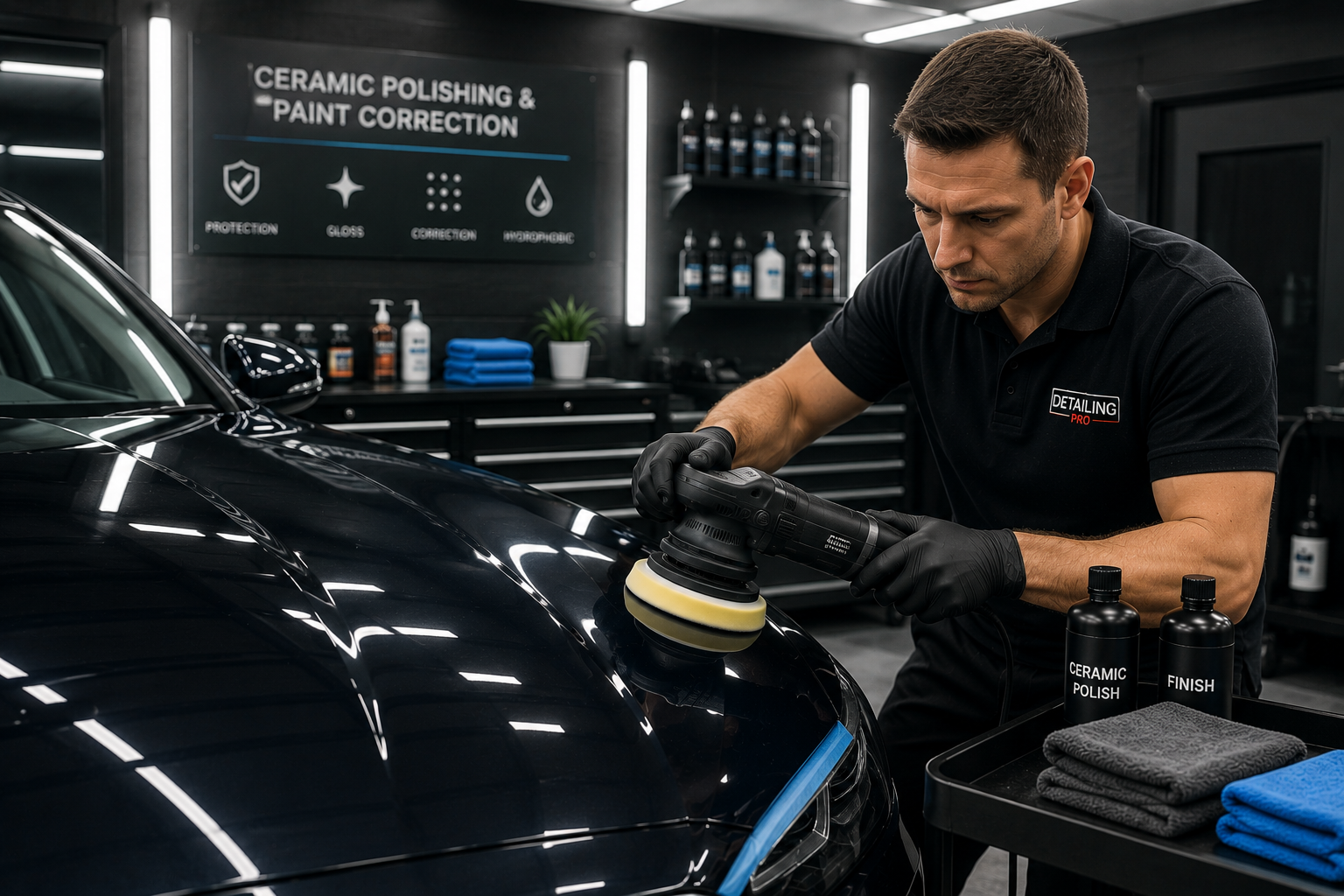
Think ceramic abrasives create a protective coating? Professional detailers often assume finishing compounds like Roar 1030 and Menzerna 3500 leave behind lasting protection. The reality exposes a critical gap in most correction workflows that could be compromising your results.
Key Takeaways
- Neither Roar 1030 nor Menzerna 3500 is a ceramic coating – both are abrasive finishing compounds designed to correct and refine paint.
- Roar 1030 uses sub-micron ceramic abrasives to eliminate swirls and defects, while Menzerna 3500 relies on nano-abrasive particles for final-stage hologram and haze removal.
- Both products are silicone-free and body-shop safe, making them suitable for professional refinishing environments.
- Ceramic protection requires a completely separate product – correction always comes first, coating comes after.
- Understanding where each product sits in the polishing sequence is what separates a flawless result from a wasted step – keep reading to see how that sequence works in practice.
The word ceramic appears in Roar 1030’s name. Menzerna 3500 is marketed with language around nano technology and ultra-fine finishing. Professional detailers and body shop technicians occasionally question whether either product crosses into ceramic coating territory. They do not – but knowing precisely what they do is what matters.
Neither Is a Ceramic Coating
A ceramic coating bonds to the paint surface and forms a durable, hydrophobic protective layer – typically containing SiO2 (silicon dioxide) and sometimes TiO2 (titanium dioxide). It does not remove defects. It sits on top of whatever finish already exists beneath it.
Roar 1030 and Menzerna 3500 do the opposite. They mechanically work into the paint surface using abrasive particles, levelling microscopic imperfections to produce a refined, high-clarity finish. No protective layer is deposited. No hydrophobic chemistry is involved. These are correction and refinement tools – not protection products.
The confusion typically stems from marketing language. Ceramic abrasive describes the type of mineral used in the compound, not the type of finish left behind. Once that distinction is clear, the role of each product becomes much easier to apply correctly in a workflow. Professionals browsing the range at IPS Paint’s detailing shop will find both products sitting firmly in the correction category, which is exactly where they belong.
What Each Product Actually Does
Roar 1030: Ceramic Abrasive Finishing Compound
Roar 1030 is classified as a Ceramic Ultra Fine Finishing Compound. Its abrasive system uses sub-micron ceramic particles – an exceptionally fine mineral that cuts gently but effectively, eliminating swirl marks, light scratches and holograms without introducing new marring.
The result is an ultra-high gloss, mirror-like finish. The ceramic in the name refers entirely to the abrasive mineral used – not to any coating technology. Think of it as a highly refined cutting tool that happens to use ceramic-grade particles for greater precision.
Menzerna 3500: Nano-Abrasive Super Finish Polish
Menzerna 3500 is a Super Finish Polish. It uses nano-abrasive particles – finer in scale than conventional micro-abrasives – to remove light imperfections, micro-scratches and holograms left by earlier correction stages.
Like Roar 1030, the end goal is a flawless, mirror-like surface with maximum optical clarity. The nano-scale abrasive means the particles are exceptionally small, allowing for a very precise level of paint refinement. No protective layer, no SiO2 chemistry – just a controlled abrasive action.
How Abrasives Create Gloss
Surface defects like swirl marks and micro-scratches scatter light in multiple directions. The paint looks dull, hazy or lacking in depth because reflections are broken up rather than returning uniformly to the eye. Abrasive compounds work by microscopically levelling the paint surface. As the abrasive particles break down during machine polishing, they become progressively finer, gradually reducing the size of surface irregularities until reflections sharpen and gloss increases.
That improvement is permanent in the paint itself – not a coating sitting over existing defects. The clarity and gloss created by Roar 1030 or Menzerna 3500 reflect the actual physical condition of the refined paintwork.
Where Each Product Sits in the Correction Stage
Menzerna 3500: Final Hologram and Haze Removal
Menzerna 3500 is typically used as the final step in a multi-stage correction process. After a more aggressive compound has addressed deeper defects, 3500 removes the haze, light marring and holograms that heavier correction stages leave behind. Applied with a soft foam finishing pad on a machine polisher, it refines the surface to a defect-free, high-gloss state ready for protection.
Its nano-abrasive formulation is gentle enough to use on paint that has already been through heavier work, without risking new marring or swirl marks.
Roar 1030: Swirl and Defect Elimination Before Protection
Roar 1030 occupies a similar position – a final or near-final correction stage – but its sub-micron ceramic abrasive system gives it slightly more bite. That makes it effective at eliminating swirl marks and light scratches, rather than purely removing haze left by previous stages. It is a strong choice when the paint still carries visible swirling or fine defects that need addressing before any protection is applied.
In a professional body shop setting, Roar 1030 is often the last correction step before the technician prepares the surface for sealing or coating.
Paint Compatibility: Which Surfaces Do They Cover?
Roar 1030 on UHS and Scratch-Resistant Clear Coats
Modern paint systems – particularly UHS (Ultra High Solid) and SR (Scratch Resistant) clear coats – are significantly harder and more chemically resistant than conventional finishes. That hardness requires abrasives capable of working effectively without excessive heat or pressure.
Roar 1030 is specifically formulated for compatibility across all paint systems, including UHS and SR clear coats. For body shops handling freshly sprayed panels or modern OEM finishes, that broad compatibility removes the guesswork from product selection.
Menzerna 3500 on Ceramic and Conventional Clear Coats
Menzerna 3500 is effective on both ceramic clear coats and conventional lacquers. It is capable of removing defects down to the level of 2,500-grit sanding scratches – useful context for any detailer or technician who wet-sands before polishing. The nano-abrasive system is gentle enough not to compromise either coating type, making 3500 a versatile finishing choice across a wide range of vehicles.
Body Shop Safe: Silicone-Free Formulations
Silicone contamination is a genuine risk in professional refinishing environments. Even trace amounts left on a panel can cause adhesion failures, fisheye defects and rejected paintwork – problems that are expensive and time-consuming to resolve.
Both Roar 1030 and Menzerna 3500 are formulated without silicones. Menzerna 3500 is a water-based product, free from silicones, waxes, glazes and fillers. Roar 1030 carries the same silicone-free specification. That shared characteristic makes both products safe for use in active body shop environments where overspray, wet panels and adhesion-sensitive surfaces are part of the daily workflow – with no risk of contamination carried from the polishing stage into subsequent painting or coating operations.
Correction Done – Protection Is a Separate Step
Once Roar 1030 or Menzerna 3500 has brought the paint to its best possible condition, the surface is prepared – not protected. That distinction matters enormously in a professional workflow.
A corrected surface is clean, flat and optically clear. It is the ideal foundation for a ceramic coating, paint sealant or wax – but applying any of those is an entirely separate process using an entirely separate product. Menzerna recommends following 3500 with a dedicated Menzerna Protection product to seal the corrected finish. The same logic applies with Roar 1030: correction is complete, so the next step is choosing the appropriate protection for the job.
Skipping that separation – assuming that a finishing compound offers any lasting protection – leaves the refined paintwork exposed. The correction work is done; the protection step is still to come. Getting the sequence right is what delivers a result that both looks exceptional and holds up over time.
For professional-grade finishing compounds, polishes and detailing products trusted by body shops and detailers across the UK, visit IPS Paint – a specialist supplier with the depth of range to support every stage of the correction and protection process.