
Farecla G3 Extra Plus vs P1 Nano: Cut Level Differences Explained
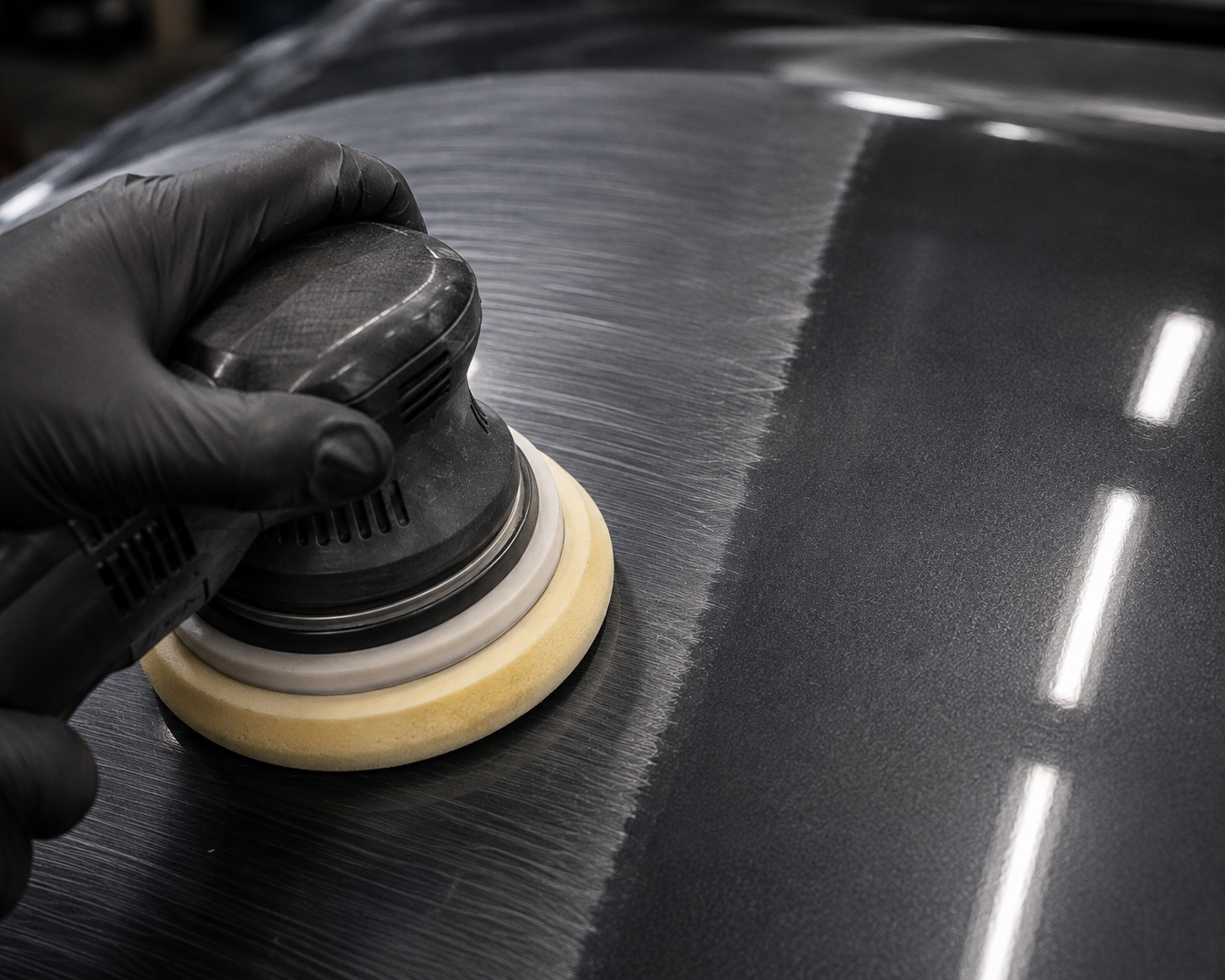
Choosing the wrong cutting compound can waste hours and remove unnecessary clear coat. But here’s what most detailers miss: defect severity, not brand preference, should dictate your choice. The difference between P1500 correction and fine swirl removal changes everything about your workflow.
Key Takeaways
- Farecla G3 Extra Plus is a medium-to-high cut compound designed to remove P1500 sanding marks, making it the go-to for heavy paint correction work.
- Gtechniq P1 Nano uses nano abrasive technology to target finer defects like swirl marks and holograms, offering a refined cut that often eliminates the need for a separate finishing polish.
- The right choice depends almost entirely on defect severity: the deeper the damage, the stronger the case for G3 Extra Plus.
- Both compounds work with rotary and dual-action polishers, but pad selection plays a significant role in how each one performs – worth reading into before committing to a process.
- IPS Paint stocks Farecla products across the full professional range – a useful reference point when speccing out a correction workflow.
Choosing between these two compounds is straightforward once you understand what each is built to do. The comparison tends to trip people up because both are marketed as professional-grade, high-performance options – but they target different stages of paint correction and different starting conditions. Below is a clear breakdown of where each one sits and when to reach for it.
One Cuts Harder, One Finishes Better
Farecla G3 Extra Plus and Gtechniq P1 Nano sit at different points on the correction spectrum. G3 Extra Plus hits hard – built to flatten paint aggressively and handle the kind of damage that comes off a refinishing job or a vehicle with seriously deteriorated clear coat. P1 Nano is engineered to cut efficiently while leaving a finish refined enough to walk away from without a second stage.
That is the core distinction. G3 Extra Plus prioritises correction depth. P1 Nano prioritises correction and finish quality in a single pass. Neither is universally superior – it comes down entirely to what the paint in front of you actually needs.
What Cut Level Numbers Actually Mean
Cut level in paint correction compounds is directly tied to the sanding marks a compound can reliably remove. Sanding marks are classified by grit number – the higher the number, the finer the scratch. A compound’s effective range tells you the coarsest scratch it can fully eliminate.
G3 Extra Plus Targets P1500; Gtechniq P1 Nano Works Differently
Farecla G3 Extra Plus is rated to remove P1500 sanding marks or finer. That is a relatively coarse starting point – P1500 is commonly used in body shops for flatting and keying surfaces before refinishing. The fact that G3 Extra Plus can cut through those marks puts it firmly in heavy-correction territory.
Gtechniq P1 Nano is designed to address finer defects such as swirl marks and holograms, leaving a high-gloss result. The nano abrasive system achieves meaningful cut at this finer level while still producing a refined finish – which is where the technology earns its reputation.
Why Starting Grit Matters in Body Shop Work
In a body shop workflow, the compound chosen should match the last grit used on the paint. If a panel has been flatted to P1500, reaching for P1 Nano is likely to mean slow, inefficient cutting – the compound is not designed to tackle that level of scratch. Starting with G3 Extra Plus and working down through the system is the faster, safer approach. Matching compound to starting grit protects clear coat by ensuring no more material is removed than necessary.
G3 Extra Plus: Built for Heavy Correction
Farecla G3 Extra Plus is a dedicated Stage 1 cutting compound. It goes in first on paint carrying real damage – whether that is P1500 flatting marks from a refinish job, heavy swirl marring, oxidation, or surface defects from collision repair. The medium-to-high cut level removes material quickly without demanding an overly experienced hand to manage.
Medium-to-High Cut, Silicone-Free Formula
One practical advantage in a body shop context is what is not in G3 Extra Plus: silicones and fillers. A silicone-free, filler-free formula means no contamination risk to surrounding panels or adjacent work. Paint adhesion on any subsequent respray is not compromised. Defects are removed permanently – not hidden temporarily, only to reappear after the first wash.
Working characteristics matter equally in a production environment. G3 Extra Plus is known for minimal throw-off and easy wipe-off, which reduces clean-up time between panels and keeps the workshop tidy. Those small efficiencies add up across a busy shift.
When a Follow-Up Polish Is Needed
G3 Extra Plus leaves a good gloss directly after compounding, but it is not a one-step product. On darker colours or where a hologram-free result is required, Farecla recommends following it with G3 Fine Finishing Compound. The two-stage process takes longer, but it delivers a level of clarity that a single aggressive pass rarely achieves on its own. For collision repair centres where finish quality is non-negotiable, that extra step is usually worth the time.
Gtechniq P1 Nano: Where Cut Meets Finish
Gtechniq P1 Nano approaches paint correction differently. Rather than prioritising maximum cut and leaving refinement to a second product, it is engineered to do both. The result is a compound that sits slightly lower on the aggression scale but significantly higher on finishing capability – and that trade-off makes it extremely efficient on the right job.
Nano Abrasive Technology Explained
The nano abrasive system uses advanced particles that are significantly smaller than those found in conventional compounds. Smaller abrasives produce a finer scratch pattern during cutting – so even as the compound removes material and corrects defects, the surface it leaves behind is already refined enough to produce high gloss. Conventional compounds cut with larger particles that leave a more pronounced scratch pattern, requiring a finishing polish to clear the haze. P1 Nano’s abrasive size reduces or eliminates that intermediate step on suitable paint systems.
The One-Step Efficiency Advantage
On harder modern clear coats – the type increasingly found on newer vehicles – Gtechniq P1 Nano can remove fine sanding marks, swirl marks, and holograms, leaving a finish that requires no follow-up polish. For detailers working on volume, or body shops processing newer vehicles with fine surface defects, that single-step capability represents a genuine time saving. Fewer stages, less product used, faster turnaround. On softer paints or where a finishing polish is already in the workflow, the advantage narrows – but on the right substrate, it is a meaningful efficiency gain.
Side-by-Side: Aggression vs Refinement
Farecla G3 Extra PlusGtechniq P1 NanoCut Level Medium-to-high Finer cut, high gloss finish Defect Range P1500 sanding marks or finer Fine defects: swirl marks, holograms, light sanding marks Silicone-Free Yes Yes One-Step Capable No – follow-up polish recommended Yes, on harder clear coats Primary Use Case Heavy correction, collision repair, refinishing Finer correction, speed, high-gloss finish Machine Compatibility Rotary and dual-action Rotary and dual-action
Defect Severity as the Deciding Factor
The practical decision rule is straightforward. Start with the defect, not the product. If the paint is carrying P1500 scratch marks, heavy oxidation, or damage from collision repair, G3 Extra Plus is the correct tool. If the paint has finer defects – light sanding marks, swirl marks, holograms, or minor surface imperfections on newer paint – Gtechniq P1 Nano delivers faster results and a superior finish in fewer steps.
Many detailing professionals keep both in the kit for exactly this reason. G3 Extra Plus handles the heavy lifts; P1 Nano takes over when the correction requirement is moderate but the finish standard is high and speed matters.
G3 Extra Plus Suits Heavy Correction; Gtechniq P1 Nano Wins on Speed and Finish
Farecla G3 Extra Plus and Gtechniq P1 Nano are complementary products, not competing ones. G3 Extra Plus is the right starting point for serious defect removal – P1500 flatting marks, heavy swirls, oxidised paint, or anything coming out of a body shop repair process. P1 Nano is the smarter choice when defects are finer, the paint system is harder, and the goal is a high-gloss result without a multi-stage process.
Neither compound benefits from being used in the wrong situation. Applying P1 Nano to paint that needs G3 Extra Plus means slow, frustrating correction and potentially leaving defects behind. Using G3 Extra Plus on light defects means unnecessary clear coat removal and more refinement work afterwards. Matching the compound to the defect level is the single most important decision in any correction job.
For professional-grade abrasive compounds, polishing systems, and refinishing supplies, IPS Paint supplies body shops and detailing professionals with the products needed to get results right first time.
Browse the full range of professional paint correction products at ipspaint.co.uk – an independent supplier trusted by body shops and detailers across the UK.