
Cutting Compound vs Polish: Combining Cut & Finish in Single Stage
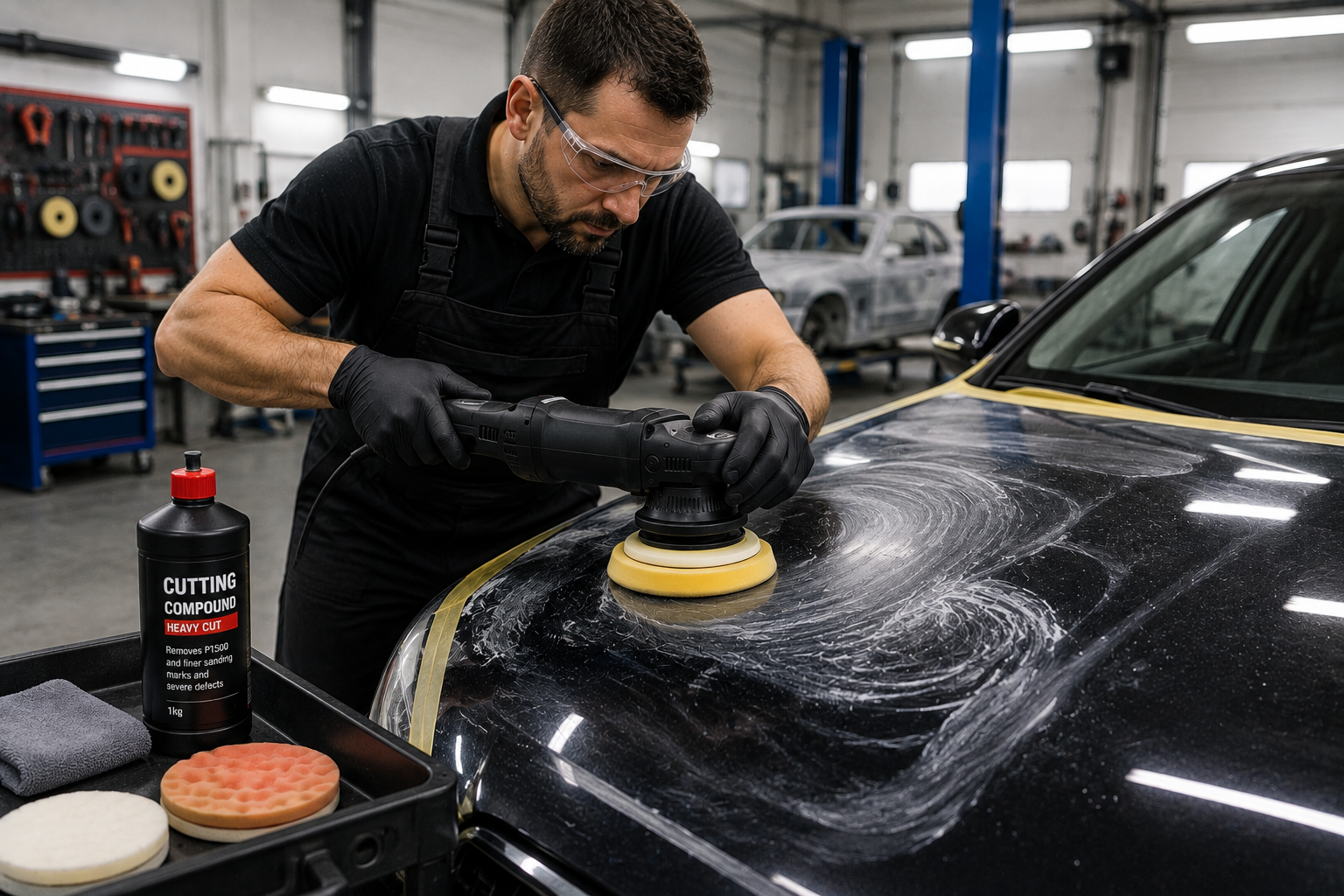
Most detailers still think correction means multiple products and endless pad changes. Modern abrasive technology changed that completely, but here’s the catch: pad selection determines whether your one-step compound actually works. Most professionals get this wrong.
Key Takeaways
- Modern diminishing abrasive technology allows a single compound to cut aggressively at the start of a polishing cycle and refine to a high-gloss finish by the end – no second product needed.
- For light to moderate defects, a one-step solution like Sonax PROFILINE Cut+Finish can dramatically reduce labour time, pad changes, and overall workflow complexity.
- Pad selection is the most underestimated variable in one-step correction – the same compound can behave very differently depending on whether a cutting, polishing, or finishing pad is used.
- Multi-stage systems still win when dealing with heavy defects, deep scratches, or coarse sanding marks; knowing when to reach for one over the other is what separates good results from great ones.
- After any correction stage, protection is essential – read on to understand why skipping that step undoes the work already done.
Paint correction used to mean a shelf full of compounds, a bag full of pads, and a full day on a single car. That has changed. Advances in abrasive chemistry have made it genuinely possible to cut and finish in one pass – and for professional detailers and body shops, that shift has real implications for how work gets priced, scheduled, and delivered.
One Product, One Pass: What Modern Abrasives Changed
Traditional correction workflows were built around a simple idea: use a coarse abrasive to remove defects, then progressively refine the surface with finer products. It worked – but it was slow. Every stage meant a new compound, often a new pad, and additional machine time per panel.
The breakthrough came from abrasive particle engineering. Modern one-step compounds are formulated with diminishing abrasives – particles that start out relatively large and aggressive, then fracture and break down into finer particles as heat and friction increase during polishing. The same product that is cutting at the start of a cycle is finishing by the end of it. Advances in abrasive particle engineering, including ceramic abrasive technology, have been particularly important here, enabling this controlled breakdown and producing superior finishes without the hazing or micro-marring that older single-product attempts or improper techniques often produced.
For professionals looking to compare one-step and multi-stage solutions side by side, IPS Paint’s professional detailing range offers a useful reference point.
How Diminishing Abrasives Work
Cut First, Then Break Down as You Work the Cycle
When a diminishing abrasive compound is first applied to a panel, the larger particles make contact with the clear coat. These particles are coarse enough to level moderate scratches, swirl marks, and light oxidation. As the machine polisher works the product – generating heat and shear force – those particles fracture into progressively smaller fragments. By the time the product is being buffed off, the abrasive left on the surface is fine enough to leave a refined, glossy finish.
This is why working the cycle fully matters. Stopping too early means the abrasive has not broken down completely, leaving behind a surface that looks flat rather than glossy.
Why Fully Working the Cycle Prevents Hazing and Micro-Marring
Hazing or micro-marring – subtle cloudiness or fine scratch patterns visible under direct light – can result from diminishing abrasives not being fully worked. True holograms, by contrast, are a distinct swirling pattern almost always caused by improper technique with a rotary buffer. When a technician rushes the cycle or uses too little pressure, the coarser particles do their cutting work but never reach their finer finishing phase. The result is a surface that looks corrected at a glance but shows interference patterns under a panel lamp.
Fully working each section of paint, maintaining consistent pressure and speed, allows the diminishing abrasives to complete their breakdown – that is when the compound stops cutting and starts polishing, and what makes a true one-step result possible.
Real Workflow Gains for Professionals
Fewer Pad Changes, Less Downtime
Every pad change on a job represents time spent: stopping the machine, removing the pad, fitting a new one, priming it, and re-establishing working pressure. Across a full vehicle, those pauses accumulate. One-step correction collapses multiple polishing stages into a single process, which means fewer pad changes per vehicle and more continuous working time per hour.
For detail studios running back-to-back appointments, that reduction in non-productive time translates directly into capacity.
Higher Throughput in Body Shops and Dealerships
Body shops report measurable improvements in vehicle throughput when one-step polishing is introduced for used car preparation and minor collision repairs. Dealerships, where the priority is getting vehicles onto the forecourt quickly with an attractive finish, have found one-step correction particularly valuable – correction and gloss restoration in a single machine stage, without sacrificing presentation quality.
For high-volume environments where consistent results need to be replicated across multiple technicians, the simplified process also reduces the margin for technique variation between operators.
Sonax PROFILINE Cut+Finish: What It Handles
Sonax PROFILINE Cut+Finish is engineered specifically around the one-step philosophy. It combines moderate cutting power with a finishing-grade result, making it a strong option for professionals who need to turn around vehicles efficiently without dropping finish quality.
Defects It Removes Effectively
On most paint systems, Sonax PROFILINE Cut+Finish handles:
- Moderate scratches and swirl marks
- Wash marring and buffer trails
- Light oxidation
- Paint overspray and dust nibs
- Light holograms
- Sanding marks up to approximately P1500 grit (paint hardness dependent)
The product is silicone-free and formulated for low dust generation – both practical considerations in a professional workshop setting.
Where Paint Hardness and Pad Choice Matter
Sonax PROFILINE Cut+Finish performs particularly well on harder clear coats, where the abrasive has enough resistance to break down correctly. On softer clear coats – common on some European OEM finishes – the compound may break down faster, which can reduce working time and cut performance. Adjusting pad choice compensates for this: a firmer cutting pad maintains aggression, while a softer polishing pad accelerates the finishing phase.
On darker colours, where any remaining micro-marring is most visible, some professionals follow with Sonax PROFILINE Perfect Finish as a final refining step to maximise depth and optical clarity.
When Multi-Stage Still Wins
Heavy Defects and Coarse Sanding Marks
One-step compounds have clear limits. For paint carrying deep scratches, severe oxidation, or sanding marks coarser than P1500, diminishing abrasives simply do not have enough initial cut to level the defect in a single pass. In these cases, a dedicated heavy cutting compound – such as those in the 3M Perfect-It system or Sonax PROFILINE Ultimate Cut 6+ – is the correct starting point, followed by a separate finishing stage.
Choosing a one-step product when the defect severity genuinely requires a heavy compound is one of the most common ways professionals waste time. More passes with an under-powered product is slower than one correct pass with the right tool.
Pad Selection: The Variable Most Detailers Underestimate
The compound is only half the equation. Pad selection determines how aggressively the abrasive makes contact with the paint, how quickly it breaks down, and what the surface looks like at the end of the cycle.
With a one-step compound like Sonax PROFILINE Cut+Finish, the same product can produce very different results depending on pad choice:
- Cutting foam pad – increases surface contact and pressure, enhancing defect removal on harder or more defect-laden paint.
- Polishing pad – balanced contact; suited to moderate corrections where both cut and gloss are needed in equal measure.
- Finishing pad – prioritises gloss over cut; useful for lightly marred paint that needs enhancement rather than correction.
Professional technicians adjust pad hardness based on paint age, clear coat thickness, scratch depth, and the desired finish level. Experienced operators achieve better outcomes not because they use more product, but because they understand how the pad and compound interact as a system.
One-Step Correction Delivers – Protect What You’ve Gained
After correction, the clear coat is in its best possible condition: levelled, refined, and free of the defects that were scattering light and dulling the finish. That is the moment protection matters most.
Leaving a freshly corrected surface unprotected exposes it immediately to UV degradation, environmental contamination, and wash-induced marring. Applying a quality wax, synthetic paint sealant, or ceramic coating locks in the improved finish and significantly extends how long the results last.
Paint correction restores the surface. Protection is what makes that restoration durable – and for clients paying for professional results, it is the difference between a finish that holds up and one that degrades within weeks.
For professional body shops and detailing studios across South Wales, IPS Paint supplies the polishing compounds, machine polishers, and refinishing products needed to work at a professional level.