
3M Perfect-It vs Menzerna Super Finish 3500: Filler-Free Formula Impact
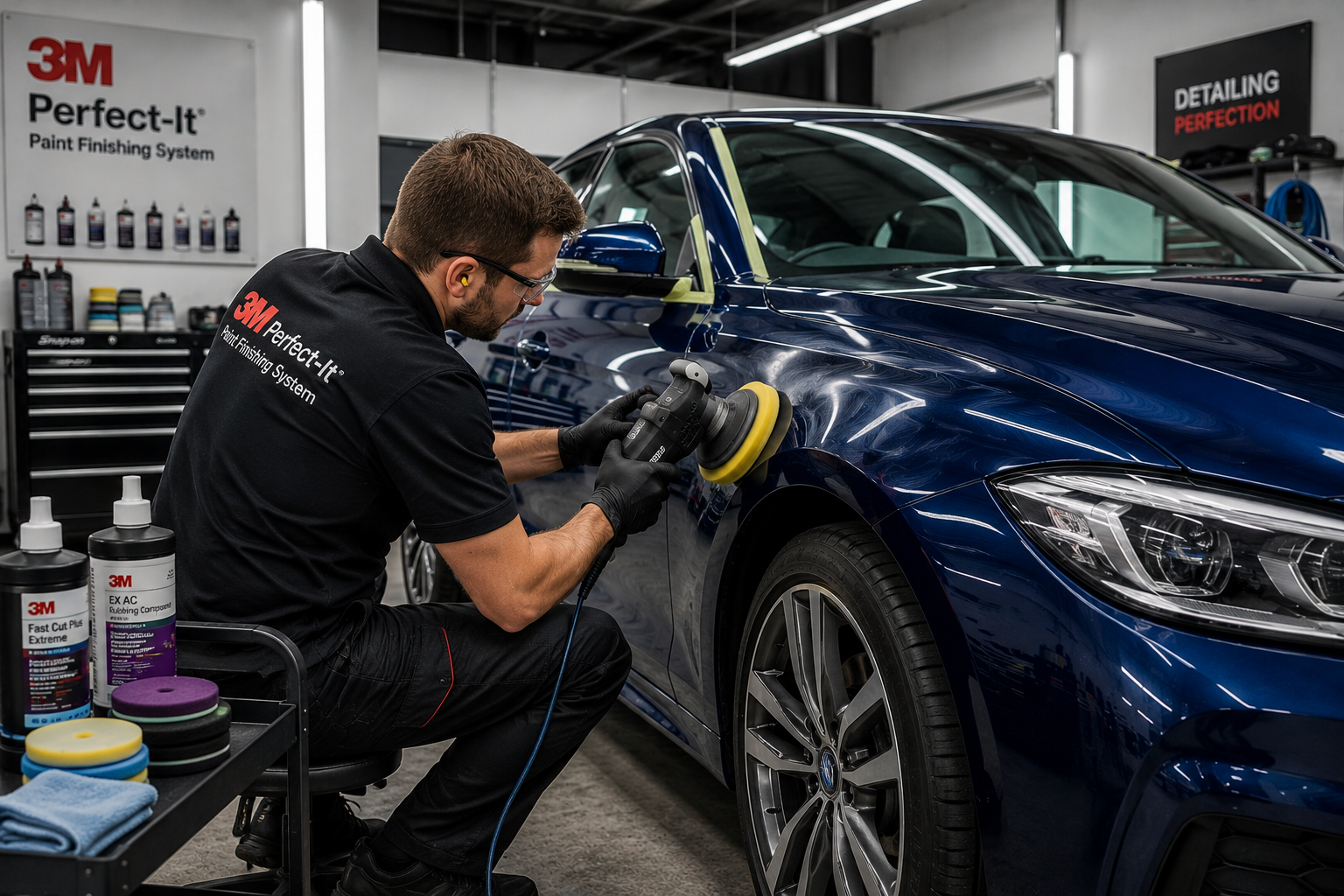
That mirror-perfect finish you achieved after polishing might be hiding a problem. Some finishing polishes mask defects rather than remove them, and the difference becomes painfully obvious on dark paint once ceramic coatings cure. Here’s what actually separates genuine correction from temporary cosmetic fixes.
Key Takeaways
- Fillers in polishes temporarily mask paint defects rather than correcting them – a critical distinction when preparing for ceramic coatings.
- Menzerna Super Finish 3500 is a genuinely filler-free polish that relies on diminishing abrasives to achieve clarity, making it the stronger choice for coating prep.
- 3M Perfect-It Ultrafine delivers highly consistent, efficient results within the 3M system, making it the preferred option in bodyshop and collision repair environments.
- On dark-coloured vehicles, the difference between filler-based and filler-free finishes becomes especially visible – understanding why this matters is key to choosing the right product.
How Fillers Distort the Final Finish
Every detailer reaches the final polishing stage with the same goal: a clean, true surface that reflects light without compromise. Not every finishing polish gets you there honestly. Some products rely on filling agents – fine waxes or silicone-based compounds – to smooth over imperfections that abrasives have not fully cleared. The result looks flawless in the bay, but the underlying surface tells a different story.
The problem surfaces later. After a handful of washes, or once a ceramic coating begins to cure, those masked defects re-emerge. Swirl marks bleed back through. Micro-scratches become visible. The finish that looked perfect at handover gradually reveals what was hidden beneath. For professionals, that is a reputation problem.
This is the central tension between 3M Perfect-It Ultrafine and Menzerna Super Finish 3500 – two finishing polishes that sit in the same market tier but approach correction with meaningfully different philosophies. IPS Paint stocks both products; visit ipspaint.shop to check current availability. Understanding which belongs in which workflow is exactly the kind of decision that separates a good result from a great one.
What Fillers Actually Do to Paint
Polishing fillers are not inherently problematic – they have legitimate uses. The issue arises when they are used at the final stage of a detail, particularly before a protective coating is applied. At that point, a filler is not solving a problem; it is hiding one.
Temporary Gloss vs. True Correction
A filler-containing polish works by depositing fine particles into surface imperfections – micro-scratches, haze, and light swirls – and levelling them optically. The paint looks corrected because light no longer scatters chaotically off those edges. The defect itself has not been removed. Once the filler breaks down through washing, UV exposure, or heat, the surface reverts.
True correction means abrasives have physically reduced or eliminated the defect. The finish is stable because the paint surface itself has changed, not just what is sitting on top of it.
The Risk on Dark Colours
Dark paint – black, deep navy, graphite – is unforgiving. Under natural or raking artificial light, even minor surface inconsistencies scatter light visibly. A filler-dependent finish that looks exceptional on a silver car can appear noticeably hazy or swirled on a black one once masking agents begin to degrade. This is why filler-free formulations matter most on darker vehicles, and why detailers working on prestige or high-value cars routinely specify them.
3M Perfect-It Ultrafine: Bodyshop Precision
The 3M Perfect-It Ultrafine Machine Polish (50383) is the final step in the 3M three-stage correction system – designed to follow the Fast Cut Plus Extreme and Extra Fine Plus compounds. In that context, it performs exceptionally well: removing residual holograms and buffer trails, lifting gloss, and delivering a consistent, repeatable finish across panels.
Filler and Silicone Considerations
The 3M Perfect-It Ultrafine formulation is generally considered to contain minimal filler activity. In standard bodyshop use – particularly on freshly painted panels – this distinction rarely causes issues. That said, proper surface decontamination after polishing and before any coating application remains good practice, regardless of the polish used, to ensure clean adhesion.
For high-volume refinishing where the goal is efficient, OEM-quality output rather than ceramic coating prep, this is rarely a practical concern. The workflow moves fast, results are consistent, and the product integrates cleanly into the wider 3M system.
Where It Excels
- Collision repair centres and professional paint shops
- High-volume environments requiring fast, repeatable results
- Freshly painted or fully cured OEM panels
- Use following 3M compounds, maximising system compatibility
- Low-dust formulation with easy wipe-off, keeping the workflow moving
Menzerna Super Finish 3500: Clarity-First Polish
Menzerna Super Finish 3500 takes a different approach entirely. Built around the principle that the finish you see should be the finish that is actually there – nothing added, nothing hidden – that clarity-first philosophy runs through every aspect of how it is formulated.
Diminishing Abrasives and Zero Masking Agents
Menzerna SF3500 uses diminishing abrasives – particles that break down progressively during the polishing cycle, starting with a finer cut and finishing even finer as heat and friction build. This allows a single product to refine the paint surface effectively without requiring aggressive abrasive action that might leave its own micro-marring. No fillers. No silicones. No masking agents of any kind.
What remains after polishing is the paint surface itself: corrected, clarified, and ready. For detailers, that transparency is the point. The finish on the pad is the finish on the car.
Where It Excels
- Pre-ceramic coating preparation where a clean, bare surface is required
- Dark and deeply pigmented paint systems where filler residue would be visible
- Soft or delicate clear coats that respond well to gentle diminishing abrasives
- High-end detailing where optical clarity is the primary metric
- Any application where the long-term durability of a protective layer matters
Ceramic Coating Prep: Why Filler-Free Matters
Ceramic coatings bond to the paint surface at a molecular level. That bond requires a clean, true substrate – free from oils, silicones, and any filler residue that might interfere with adhesion or sit between the coating and the clear coat.
When a filler-containing polish is used before coating application, there is a real risk that the coating bonds to the filler rather than the paint itself. As that filler degrades, the coating’s performance degrades with it. Longevity drops. Hydrophobic properties diminish faster than expected. Underneath, the defects that were masked at polishing stage re-emerge – now visible beneath a cured coating that cannot simply be re-polished away.
Filler-free polishes like Menzerna Super Finish 3500 eliminate this risk entirely. The surface presented to the coating is the surface that has been corrected. What the detailer sees during inspection is what the coating will bond to – no surprises three months later.
Head-to-Head: Which Polish Wins Where?
Bodyshop and Collision Repair
3M Perfect-It Ultrafine is the stronger choice here. Engineered to integrate within the 3M system, it delivers consistent results on freshly painted panels, and its low-dust, easy-wipe formulation keeps high-volume workflows efficient. Collision repair centres value repeatability, and 3M delivers that reliably.
Menzerna SF3500 can absolutely be used in a bodyshop context – it produces an outstanding finish – but its true strengths are less relevant when speed and system integration take priority over maximum optical clarity.
High-End Detailing and Coating Prep
Menzerna Super Finish 3500 wins this category clearly. The filler-free, silicone-free formulation means the surface after polishing is exactly what it appears to be. For detailers applying ceramic coatings to prestige vehicles, that certainty is non-negotiable.
It performs particularly well on softer paint systems – often found on European luxury marques – where diminishing abrasives do their finest work, leaving exceptional gloss and depth without the risk of micro-marring from over-aggressive finishing.
Factor 3M Perfect-It Ultrafine Menzerna Super Finish 3500 Filler-Free Minimal Yes Diminishing Abrasives No Yes Ceramic Coating Suitability Good Excellent Bodyshop Integration Excellent Good Dark Colour Performance Very Good Excellent Ease of Use / Wipe-Off Excellent Very Good
Menzerna SF3500 Delivers Truer Results Before Coating
The verdict comes down to what finished actually means in a given context. In a collision repair centre, finished means efficient, consistent, and OEM-quality – and 3M Perfect-It Ultrafine delivers that reliably within its system. In a high-end detailing bay, finished means the paint surface is genuinely corrected, optically clear, and ready to receive a long-term protective coating without compromise.
Menzerna Super Finish 3500’s filler-free, diminishing-abrasive formulation earns its reputation precisely because it does not hedge. The gloss it produces is real. The surface it leaves behind is clean. For detailers who need to know – not just hope – that a ceramic coating is bonding to corrected paint rather than a temporary layer of masking agents, that distinction is everything.
Both are excellent finishing polishes. Choosing between them is not about quality – it is about workflow, application, and what the next step after polishing actually is.
IPS Paint stocks a wide range of professional polishing products for bodyshops and detailers across the UK – visit ipspaint.co.uk to check the full range and current product availability.