
3M Perfect-It vs. Sonax Cut & Finish: One-Step Paint Correction Compared
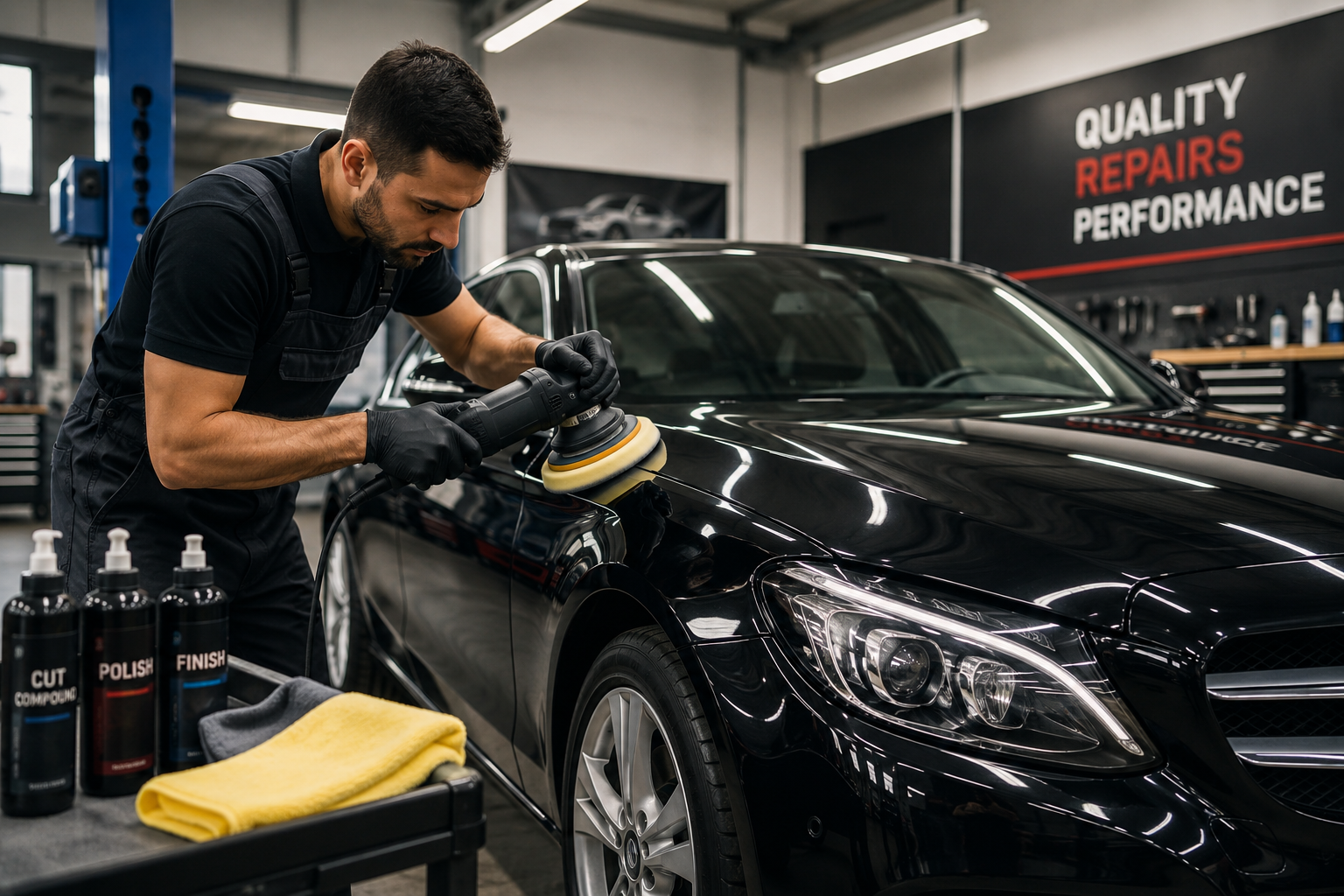
Most detailers assume pad choice barely matters compared to the compound itself, but professional workshops know it’s often the difference between acceptable results under shop lights and failures in natural sunlight. One number reveals why these two popular one-step products perform so differently.
Key Takeaways
- One-step paint correction works well for moderate defects – swirl marks, light scratches, and oxidation – but multi-stage systems still lead on heavy correction work.
- Sonax PROFILINE Cut+Finish is purpose-built for one-step workflows, combining a cut rating of 5 and a gloss rating of 5 (out of 6), which sets it apart from conventional compounds.
- 3M Perfect-It Extra Fine Plus Compound (Yellow Cap) is the closest single product in the Perfect-It range to a one-step solution – but it sits within a multi-stage system, which matters when choosing it for workshop workflows.
- Pad selection often determines whether a product cuts or finishes, regardless of what the label says – a detail that changes everything in practice.
- The right choice between these two products comes down to defect severity and how the workshop values time versus control.
One Stage, Multiple Passes: What’s Actually at Stake
Paint correction has traditionally meant committing to a full multi-stage process: heavy compound, intermediate refinement, finishing polish, then protection. That sequence exists for good reason – it gives technicians precise control at every stage. It’s also time-consuming, and not every vehicle in the workshop actually needs that level of intervention.
One-step correction products emerged as a practical response to that reality. Rather than changing pads and compounds several times, a single product handles both defect removal and surface refinement in one polishing pass. For professional detailers and body shop technicians, that means fewer pad changes, lower product consumption, and meaningfully faster turnaround on the right jobs.
The catch is that “one-step” doesn’t mean one-size-fits-all. Choosing the wrong product for the defect level – or the wrong pad for the paint – produces results that look acceptable under workshop lighting but fall apart under natural light. That’s the real decision being made here, and understanding exactly where the two leading options sit is worth the time. IPS Paint supplies both systems to professional body shops and detailers, and the full range is available at ipspaint.shop.
What One-Step Correction Can and Can’t Fix
Before comparing products, it helps to be clear about what one-step correction is actually capable of – and where it runs out of road.
Defects It Handles Well
One-step polishing is well suited to:
- Swirl marks from automated car washes or poor wash technique
- Light random scratches that haven’t broken through the clear coat
- Light oxidation on moderately weathered paint
- Wash marring and light holograms
- Sanding marks up to approximately P1500-P2000, depending on paint hardness and pad choice
On daily drivers and used-vehicle preparation work, these are the most common defects encountered. A well-chosen one-step product paired with the right pad will resolve most of them efficiently.
Where Multi-Stage Still Wins
One-step correction has a ceiling. Deep scratches, heavy oxidation, coarse sanding marks below P1500, and any surface with significant clear coat damage will need a dedicated cutting compound first. Trying to correct those defects with a one-step product risks either under-correcting the surface or over-working the clear coat chasing a result the product isn’t designed to achieve.
3M Perfect-It Extra Fine Plus: The Closest Match
The 3M Perfect-It system is built around staged correction – each product has a defined role within the sequence. That’s its strength in a body shop environment, but it also means identifying which single product from the range most closely matches a one-step workflow.
Where It Sits in the Perfect-It System
The Perfect-It lineup covers three primary roles:
- Fast Cut Plus Extreme (Green Cap) – Heavy defect removal, sanding marks from P1500-P2000
- Extra Fine Plus Compound (Yellow Cap) – Moderate defect removal, swirl marks, pre-finishing refinement
- Ultrafine Machine Polish (Blue Cap) – Final finishing, hologram removal, maximum gloss
The Extra Fine Plus Compound occupies the middle ground. It removes moderate defects while refining the surface – which is as close to a one-step outcome as the Perfect-It system produces from a single product.
Strengths for Body Shop Use
For collision repair centres and manufacturer-approved refinishing work, the structured nature of the Perfect-It system is a feature, not a limitation. Every step is repeatable and predictable across multiple technicians. The Extra Fine Plus Compound is compatible with both rotary and dual-action polishers, which suits mixed-tool workshop environments.
Professional feedback highlights fast cutting ability and a solid finish on freshly painted panels. The product is designed for moderate defect removal and pre-finishing refinement – not for coarse sanding marks, which require the more aggressive Fast Cut Plus Extreme.
Sonax PROFILINE Cut+Finish: Built for One Step
Sonax PROFILINE Cut+Finish is designed from the ground up for one-step workflows. That distinction matters – it isn’t an intermediate product borrowed from a multi-stage system; it’s engineered specifically to combine cutting and finishing in a single polishing pass.
Cutting Power vs. Gloss Output
Sonax rates the PROFILINE Cut+Finish at 5 for cut and 5 for gloss on a scale of 1-6. That dual performance is the product’s defining characteristic. Conventional compounds typically score high on cut but low on gloss – a 5/1 split is common – requiring a separate finishing stage to refine the surface. Getting both scores to 5 in one product changes the economics of the job significantly.
It handles sanding marks up to P1500 grit effectively, removes dust nibs, paint overspray, and light oxidation, and produces a high-gloss result without a follow-up polish on most paint systems. The formula is silicone-free and generates low dust, which reduces cleanup time and makes it practical in shared workshop spaces.
On darker colours or softer clear coats, some professionals find that following with Sonax PROFILINE Perfect Finish adds noticeable depth – but on the majority of moderate correction jobs, Cut+Finish completes the task on its own.
Limitations of the One-Step Process
PROFILINE Cut+Finish isn’t intended to replace dedicated cutting compounds on heavy correction work. Very hard paints can limit its cutting effectiveness, and on paint with deep scratches or severe oxidation, a more aggressive first step is still needed. The product performs between those extremes: where moderate correction and high gloss are both needed from a single pass.
Head-to-Head: Efficiency in the Workshop
Labour Time, Working Time, and Product Consumption
Workshop efficiency goes beyond how fast a compound cuts. Total time from starting the polishing stage to moving the vehicle out – including pad changes, product application, wipe-off, and inspection – is what actually matters.
Sonax PROFILINE Cut+Finish reduces that total time on moderate correction jobs by eliminating the separate finishing stage. Fewer products to apply, fewer pad changes, and a clean wipe-off characteristic all contribute. For high-volume detailing studios and dealership preparation work, that efficiency adds up across multiple vehicles per day.
The full 3M Perfect-It system involves more stages but gives technicians more control at each step. For a body shop processing insurance repairs or refinished panels, that control – and the consistency it produces – justifies the additional time invested.
Which Repairs Suit Each Product
- Sonax PROFILINE Cut+Finish suits: used-vehicle preparation, dealership enhancement details, SMART repairs, daily driver correction, one-step workflows where time efficiency is a priority.
- 3M Perfect-It Extra Fine Plus Compound suits: freshly painted panels, moderate correction as part of a staged system, body shops requiring repeatable multi-step workflows, collision repair environments where consistency across technicians matters.
Pad Selection Changes Everything
Pad choice often has more influence over the final result than the compound itself. A cutting foam pad behind Sonax PROFILINE Cut+Finish will behave very differently to a finishing pad – more aggressive correction, less immediate gloss. The same applies to the 3M Extra Fine Plus Compound.
Experienced technicians adjust their pad combination based on paint hardness, clear coat thickness, vehicle age, and scratch depth. On harder European clear coats, a more aggressive pad may be needed to achieve full correction. On softer paint systems, a polishing pad often produces better results with less risk of burning through – though paint hardness varies even within the same region of manufacture, so a test spot should always guide the final pad choice.
Treating pad selection as a fixed variable – rather than an active part of the correction strategy – is one of the most common reasons professionals get inconsistent results from otherwise capable products.
Sonax Saves Time on Moderate Defects; the Full 3M Perfect-It System Takes Control for Heavy Correction
These two products solve overlapping but distinct problems. Sonax PROFILINE Cut+Finish is the stronger choice when a single-pass outcome on moderate defects is the goal and workshop time has direct commercial value. Its purpose-built one-step formulation, low dusting, and dual cut-and-gloss performance make it a genuine efficiency tool for detailers and dealership preparation teams.
The 3M Perfect-It system – with the Extra Fine Plus Compound as the closest analogue to a one-step product – delivers staged correction with a level of control and repeatability that suits body shop environments, freshly refinished panels, and jobs where quality is the priority over speed. When defects go beyond moderate, the full Perfect-It system simply has more range.
Matching the product to the defect severity, then dialling in the right pad combination, is where professional results actually come from – not from defaulting to the most aggressive option on the shelf.
For professional-grade polishing compounds, machine polishers, and refinishing consumables, IPS Paint supplies body shops and automotive detailers with the products and technical knowledge to match the right solution to every job.