
How to Calculate the True Cost Per Vehicle of Valeting Concentrates
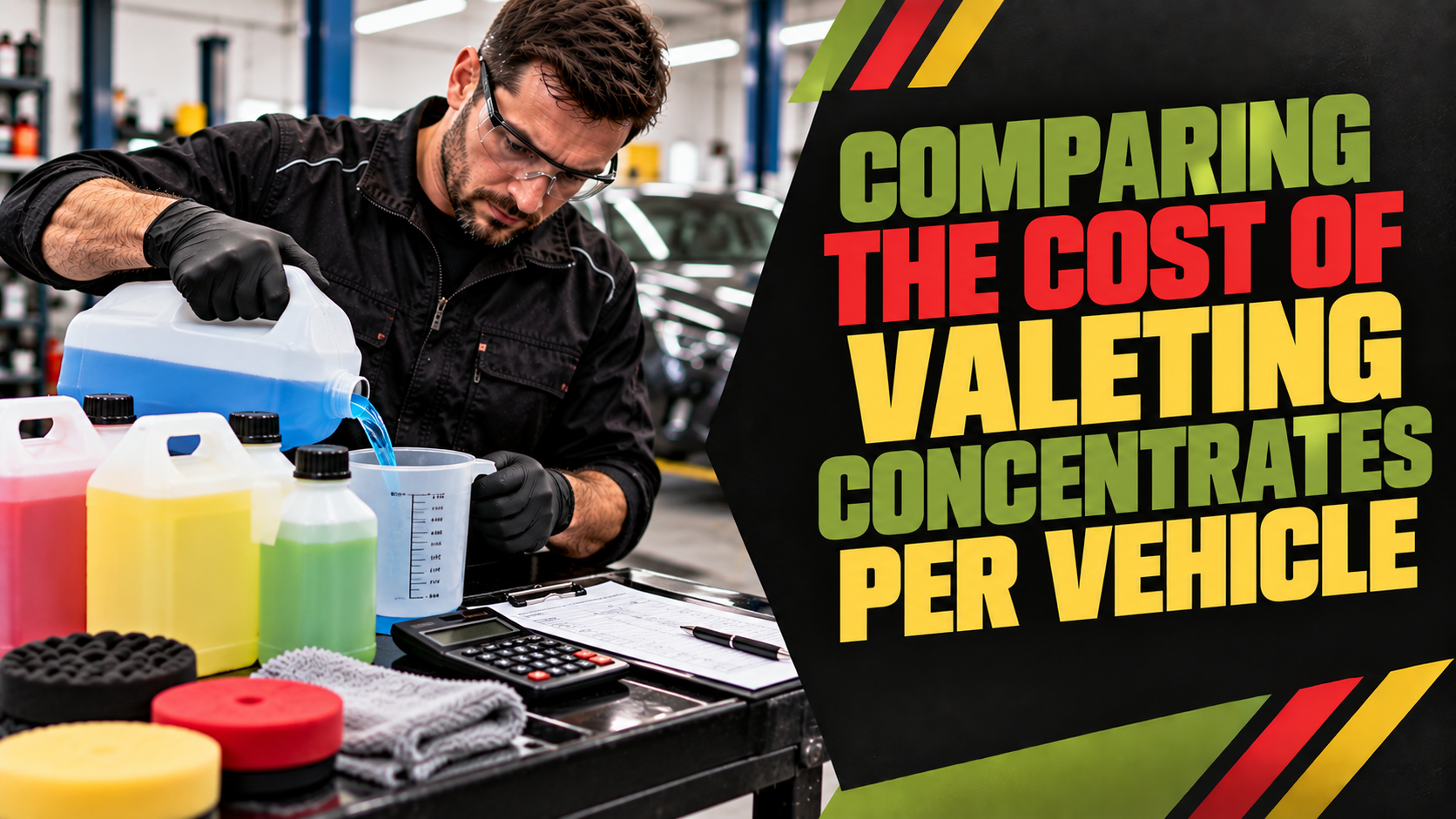
A larger bottle or concentrated valeting product is not automatically better value. Trade buyers should compare how much correctly prepared product is used per vehicle. Pack price, dilution and working volume all matter when calculating the true chemical cost of each valeting job accurately.
Key Takeaways
- Pack price alone does not show the real cost of using a concentrated valeting product.
- Start with a defined task, then use the current pack price and manufacturer’s dilution instructions for that exact application.
- Calculate how much concentrate is used in the working solution normally consumed on one vehicle.
- Cost per vehicle allows suitable concentrates with different pack sizes and dilution rates to be compared on a more consistent basis.
- Dilution should always follow the manufacturer’s instructions rather than being changed simply to reduce the apparent cost per wash.Pre-washing has become a standard first step for anyone serious about looking after a vehicle’s paintwork, yet the choice between snow foam and traffic film remover still causes confusion. Both products loosen dirt before a wash mitt touches the surface, but they are built for different jobs rather than sitting on a scale of weak to strong. Matching the product to the task, rather than assuming the one with the fiercest reputation always wins, makes the difference between a safe, effective wash and one that risks the finish.
Calculate Cost Per Vehicle, Not Cost Per Bottle
Start with a clearly defined task, such as an exterior pre-wash on a medium-sized car. Then record the current pack price, pack volume and the manufacturer’s dilution instructions for that exact use.
Next, calculate how much concentrate goes into the correctly prepared working solution and how much of that solution is normally used on one vehicle. This gives the amount of concentrate consumed per job.
For example, if an illustrative product costs £20 for two litres and 100 ml of concentrate is used per vehicle, the chemical cost is £1 per vehicle. This is an arithmetic example only; it is not an IPS price, product dilution or recommended dose.
The same calculation can then be repeated for another suitable product. This makes it possible to compare different pack sizes and concentrations on the basis of actual chemical consumption rather than shelf price alone.
Use the Manufacturer’s Dilution for the Calculation
Use the manufacturer’s current dilution instructions for the exact task when calculating cost. Do not assume that every concentrate uses the same ratio convention or make the solution stronger or weaker simply to alter the calculated cost per vehicle.
The important figure is how much concentrate is actually consumed in the correctly prepared solution used for the job. Record that working volume consistently so future product comparisons are based on the same task and process.
A highly concentrated product may produce more working solution from a pack, but that does not automatically make it better value. Suitability for the task, correct use and the result achieved still need to be considered alongside chemical cost.
Keep the Comparison Like-for-Like
Cost comparisons only make sense between products that are suitable for the same task. A cheaper cost per working litre is not useful if the product is not approved for the surface or application being considered.
Define the job first, identify suitable products and then compare their correctly prepared cost. This prevents a purchasing calculation from favouring an unsuitable product simply because its dilution or pack price produces a lower headline figure.
Turn the Calculation Into a Purchasing Tool
For a busy valeting operation, bodyshop or fleet, cost per vehicle provides a more useful purchasing measure than pack price alone. Using the current price, manufacturer-approved dilution and normal working volume for a defined task gives buyers a repeatable way to compare suitable concentrates.
The calculation should also be updated when product prices, dilution instructions or workshop processes change. Used consistently, it can help identify unnecessary chemical consumption and give the business a clearer picture of the direct product cost behind each job.
Trade buyers can review professional valeting and detailing concentrates available from IPS Paint and apply the same calculation to products suitable for their particular tasks.