
Polishing Holograms: Find the Cause Before Reworking the Panel
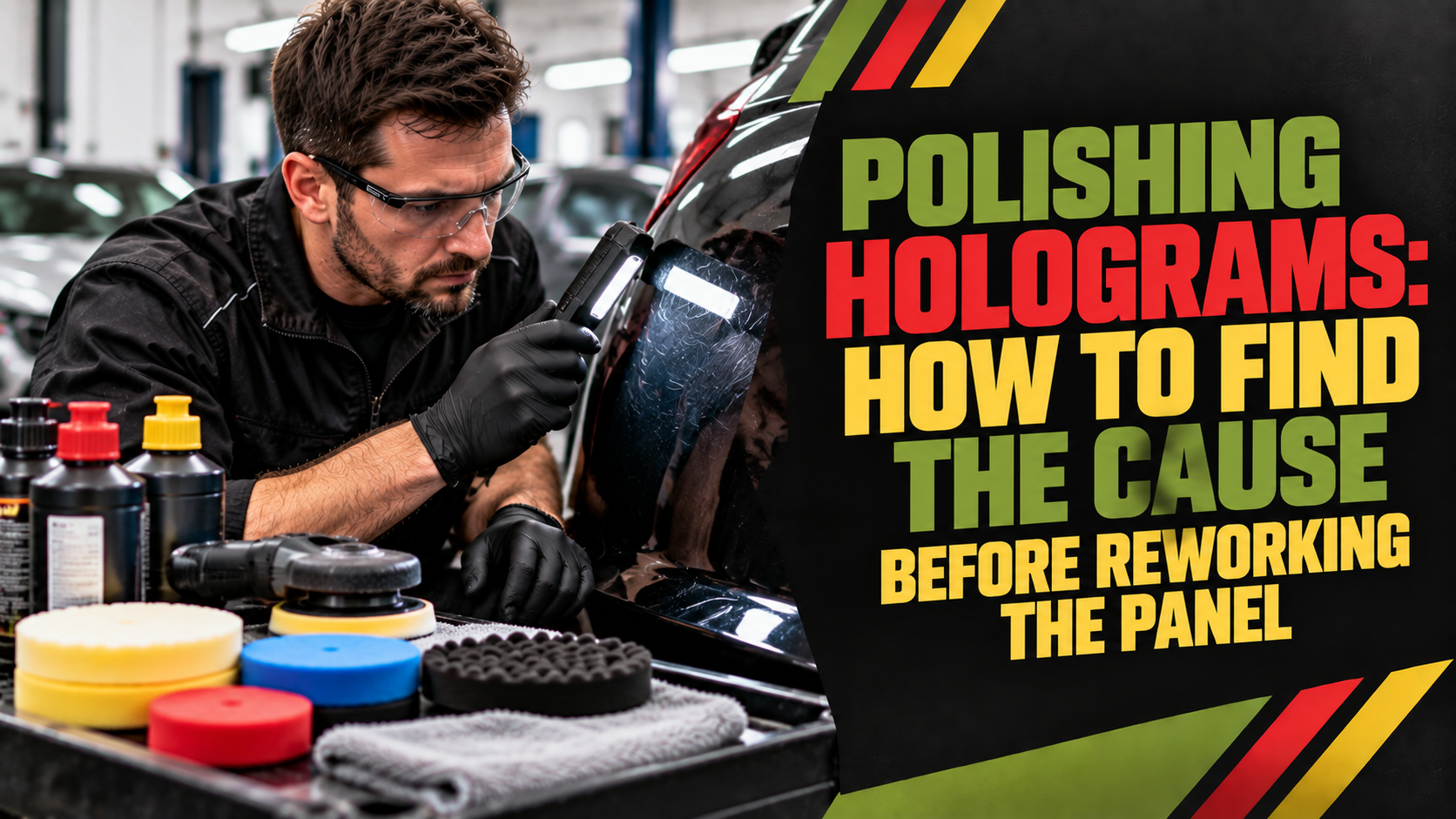
That flawless respray can hide a costly secret: shimmering holograms that only appear under direct sunlight. Before you grab the buffer again, learn why dark panels reveal them fastest and what really causes those swirling buffer trails.
Key Takeaways
- Holograms can result from several factors in the machine-polishing process, including excessive pressure or heat, compound drying out, pad condition and the compound-and-pad combination.
- Identifying the likely cause before reworking the panel helps avoid repeating the defect or removing more coating than necessary. actual cause rather than assuming the source
- A silicone-free label is a useful screening question but does not guarantee a product suits every surface or repair stage, and the full working process still needs checking
- Separating tools, products and work zones between valeting and refinishing areas helps stop contamination reaching a surface prepared for paint
- Reading beyond a single formulation label is essential when choosing products for repair zones
Holograms have a way of ruining an otherwise perfect panel. A car rolls out looking flawless under the workshop lights, only for the customer to spot shimmering, cloudy patterns the moment it sits under direct sun. For a refinish shop manager, that moment is expensive, both in reputation and in the time it takes to put right.
Spotting Holograms Before They Cost You
Holograms, sometimes called buffer trails or machine marks, are fine linear scratches that catch the light in a way that creates a swirling, almost 3D-looking pattern. They tend to shimmer and shift as the viewing angle changes, which makes them easy to miss under artificial lighting but impossible to hide once a vehicle is parked outside. Dark paintwork gives them away fastest, with black, dark blue, dark grey and dark red panels showing the highest contrast between the defect and the surrounding gloss.
The frustrating part is how often these marks go unnoticed at handover. A glaze or wax applied over the top can mask the problem for weeks, only for it to resurface once that protective layer wears away. Checking finished panels in direct sunlight, from several angles, catches holograms before a customer does, and that single habit can save a shop from a comeback job. Understanding why holograms form is what separates a quick polish-out from a repeat rework, and that thinking forms the foundation for the rest of this guide.
Getting ahead of the problem starts with knowing exactly what causes it, which is where the next section comes in.
What Causes These Buffer Trails
Holograms are, at their core, fine scratches worked into the paint by machine polishing, made worse when an aggressive pad or polish is involved. They rarely appear from one single error. Instead, a combination of machine settings, product condition and technique tends to be responsible, which is exactly why diagnosing the cause matters more than simply buffing the panel again.
Rotary Speed, Pressure and Dry Pads
Several parts of the machine-polishing process can contribute to holograms. Excessive pressure or heat, compound drying out, pad condition and an unsuitable compound-and-pad combination should all be checked before the panel is reworked. Confirm that the machine and pad are appropriate for the polishing system and follow the manufacturer’s recommended settings and technique.
Skipping or Rushing the Finishing Stage
The finishing stage should be checked as part of the diagnosis. If the compound stage has left haze or holograms, follow the polishing system’s specified refinement or finishing process rather than repeatedly making aggressive passes. The required combination will depend on the coating, compound, pad, machine and manufacturer’s instructions.
Worn or Low-Quality Polish and Pads
Polish that has dried out or turned gritty with age no longer refines a surface, it scuffs it. The same applies to pads that have hardened, picked up dried product residue, or simply seen too many jobs. A hard edge of dried compound on a pad face can score paint just as easily as an aggressive abrasive can, so pad condition deserves the same attention as the polish itself.
Holograms vs Ordinary Swirl Marks
Holograms are a form of swirl mark, and both can trace back to poor washing technique, incorrect drying, or general abrasion from dirt trapped in a cloth or mitt, along with machine polishing that goes wrong. What sets holograms apart visually is their more uniform, circular pattern, which seems to move as the light changes, compared with the more random, spiderweb-like look of typical wash-induced swirls.
The distinction still matters for diagnosis, because the fix depends on where the defect actually originated. Marks tracing back to the wash bay call for better contact-wash habits and cleaner drying tools. Marks tracing back to a machine polishing pass call for a look at pad choice, product condition, speed, pressure and finishing technique. Assuming a cause without checking leads to reworking the wrong part of the process, which wastes time without solving anything.
Correcting the Panel Without Repeating the Mistake
Once holograms are confirmed, correcting them without repeating the same mistake calls for a considered pad and polish approach rather than another aggressive pass with the same setup that caused the problem.
Choosing the Right Pad and Polish Combination
Once holograms are confirmed, return to a small test area rather than immediately repeating the previous polishing process. Check the condition of the pad, confirm that the machine, compound and pad are an appropriate combination, and follow the polishing system’s recommended refinement process. Change one variable at a time and inspect the result before working across the full panel.
Technique: Pressure, Passes and Lubrication
Technique carries as much weight as the products themselves. A few habits worth building into every job:
- Apply light to moderate pressure and keep the pad flat against the panel rather than tilting it, which avoids uneven scratching.
- Work in slow, overlapping passes so the polish has time to break down properly rather than skating across the surface.
- Never dry buff. There should always be enough product on the pad to lubricate the surface and let it glide rather than drag.
- Keep pads clean throughout the job, swapping or washing them once product starts to dry on the face.
- Test on a small area first, especially on an unfamiliar paint system, before working across a full panel.
Following this sequence consistently is what stops a correction job simply reintroducing the same defect it was meant to remove.
Inspecting the Finish Before Handover
After polishing, remove residue using a surface preparation method that is approved for the paint and stage of work. Inspect the panel from more than one angle under suitable lighting, as holograms can become much more obvious under strong directional light, particularly on darker colours.
If marks remain, return to a small test area rather than immediately reworking the whole panel. Change one variable at a time and inspect the result. Once the correct combination has been established, recording the machine, pad, product and process used gives other technicians a repeatable starting point for similar work.
Root-Cause Fixes Prevent Repeat Reworks
Holograms and contamination both share the same lesson: treating the symptom without understanding the cause simply invites the same job back around again. A panel buffed with the wrong pad will hologram again under the next aggressive pass, just as a valet product moved into the wrong zone will contaminate the next surface prepared for paint. Slowing down to identify why a defect happened, rather than jumping straight to reworking the panel, is what actually breaks the cycle.
For a shop working through a hologram correction or reviewing its contamination policy, having the right pads, polishes and silicone-free options on hand from the outset makes root-cause fixes far easier to put into practice. Browsing a range of bodyshop-ready polishing and valeting supplies is a sensible next step for stocking a workshop against both problems.