
Roar 1020 vs Chemical Guys: Correction vs Protection Difference
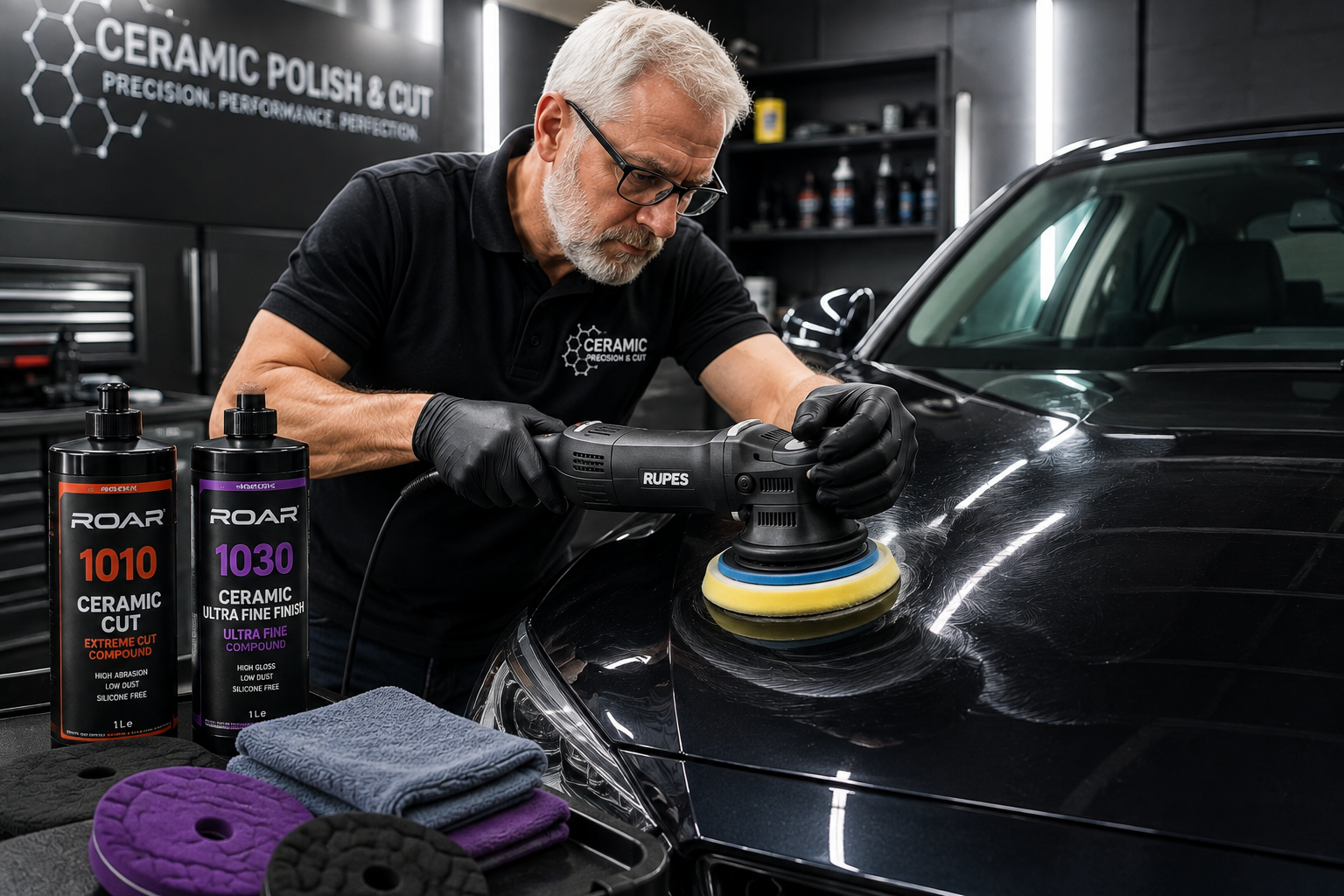
Most detailers don’t realize they’re sealing in swirl marks when they apply ceramic protection to uncorrected paint. The difference between products that fix defects and products that protect becomes painfully obvious on black vehicles, where poor sequencing actually makes imperfections more visible.
Key Takeaways
- ROAR 1020 Ceramic Finish is a paint correction compound – it permanently removes swirl marks and refines the clear coat. It is not a protective coating.
- Chemical Guys HydroSlick Intense Gloss SiO₂ Ceramic Coating HyperWax is a paint protection product – it adds a durable ceramic layer over the surface but does not remove defects.
- These products do completely different jobs, and using one does not replace the other – the most effective professional workflow combines both in the right order.
- Black paint makes the difference between correction and protection especially visible, and is one of the most important scenarios where sequence matters – more on that below.
- IPS Paint supplies ROAR 1020 and offers practical guidance to help professional detailers and body shop technicians choose the right approach for each job.
There is a persistent mix-up in the detailing world between products that fix paint and products that protect it. That confusion can lead to money spent in the wrong order, or worse – a ceramic coating bonded over defects that were never actually removed. This article breaks down the real difference between ROAR 1020 Ceramic Finish and Chemical Guys HydroSlick Intense Gloss SiO₂ Ceramic Coating HyperWax, and why understanding that difference is fundamental to producing genuinely high-quality results.
Two Products, Two Completely Different Jobs
At first glance, both products sound similar – both reference ceramics, both promise gloss, and both sit at a comparable price point in the UK (ROAR 1020 at £41.99 per 1kg; HydroSlick at £42.99 for 16oz). Their chemistry, application method, and purpose, however, are entirely different.
ROAR 1020 is a finishing compound. It uses abrasive refinement to mechanically correct the clear coat – permanently removing swirl marks, micro-marring, holograms, and polishing haze. Chemical Guys HydroSlick is a SiO₂ ceramic HyperWax. It bonds a protective ceramic layer over the paint surface, adding gloss, hydrophobicity, and claimed durability of up to 12 months. One works on the paint. The other works over it.
You can find ROAR 1020 – along with professional-grade guidance on correction and protection workflows – at IPS Paint’s online shop, stocked for trade and professional use.
What ROAR 1020 Actually Does to Paint
ROAR 1020 sits at the finishing stage of the paint correction process. After heavier compounding has addressed deeper scratches, the surface often still shows fine swirls, haze, and holograms under inspection lighting. ROAR 1020 targets those finishing-level defects – refining the clear coat until it reflects light cleanly.
Permanent Swirl Removal, Not a Coating
The word permanent matters here. When a swirl mark is mechanically corrected, the defect is gone – not filled, not hidden beneath a layer of product, but physically removed from the surface. That correction does not wash away after six months. New swirls can be introduced through poor wash technique or abrasion, but the original defect has been genuinely eliminated. This is a fundamentally different kind of durability from what a protective coating offers.
Why Silicone-Free Matters in a Body Shop
ROAR 1020 is silicone-free and body-shop safe. In a refinishing environment, silicone contamination is a serious problem – it causes paint adhesion failures and fisheye defects in fresh paint. A finishing compound that leaves silicone residue creates downstream problems. ROAR 1020 is formulated to be safe in that environment, making it directly relevant to technicians completing automotive refinishing work who need to correct and refine a panel without compromising any subsequent paint application.
What HydroSlick Does Instead
Chemical Guys HydroSlick takes a completely different approach. Rather than refining the paint surface, it deposits a SiO₂ ceramic layer on top of it. That layer is designed to enhance gloss, repel water and environmental contamination, and provide UV protection. Chemical Guys describes it as a genuine ceramic coating in a wax-like application format – which is a significant part of its appeal.
SiO₂ Protection Over the Surface
The SiO₂ technology in HydroSlick creates a hydrophobic surface that causes water to bead and roll away, making the vehicle easier to maintain between washes and reducing water spotting. It also adds depth and colour richness that many detailers associate with a premium ceramic finish. These are real, measurable benefits – they have nothing to do with correcting the paint underneath.
12 Months Claimed – 3 to 6 More Realistic for Daily Drivers
Chemical Guys claims up to 12 months of protection from HydroSlick. On a daily driver subject to regular washing, road contamination, and varying weather, a more realistic expectation sits closer to three to six months. That is not a criticism of the product – it is simply the reality of any spray or wax-format ceramic versus a fully cured multi-layer coating. Setting client expectations accurately is part of delivering a professional service.
Gloss: Corrective vs Protective
Both products produce impressive-looking paint, but the mechanism differs entirely. ROAR 1020 creates gloss by removing the microscopic surface defects that scatter and diffuse light. Once those are gone, the clear coat reflects cleanly – the gloss comes from the condition of the paint itself. HydroSlick creates gloss by adding a ceramic layer that enhances depth, colour saturation, and surface slickness. Think of it as corrective gloss versus enhancement gloss. On a badly swirled vehicle, ROAR’s correction often delivers the more dramatic visual transformation. On already-refined paint, HydroSlick adds the final ceramic depth that makes the finish genuinely stand out.
Durability Is Not One Thing
Durability is often used as a single measure when comparing detailing products, but it actually describes two different things depending on which product is under discussion.
Permanence of Correction
When ROAR 1020 removes a swirl, that correction is permanent in the sense that the defect no longer exists in the paint. There is no clock running on it. The correction does not degrade or peel away – the clear coat has been physically refined.
Lifespan of Protection
HydroSlick’s durability refers to the lifespan of its ceramic layer. Chemical Guys claims up to 12 months, and that protection will gradually diminish with washing, UV exposure, and environmental contact. This is exactly what a sacrificial protective layer is designed to do – take the punishment so the paint underneath does not have to. Conflating these two forms of longevity leads to poor product choices.
Skill Gap Between Correction and Protection
One of the clearest practical differences between these two products is how much skill their application requires.
HydroSlick: Wax-Like Application
Chemical Guys deliberately designed HydroSlick to be applied like a conventional wax. Work it into the panel with an applicator, allow it to haze briefly, then buff away with a clean microfibre. The hydrophobic properties continue developing for up to 24 hours. It is accessible enough for enthusiast DIY use, which is a genuine design strength.
ROAR 1020: Easy to Handle, Demanding to Master
ROAR 1020 requires machine polishing technique. That means understanding paint hardness, selecting the right pad – ROAR recommends their 6-inch Waffle Black Foam Pad (620PF) – managing working time, and knowing when to stop cutting without burning through the clear coat. The complexity reflects the more demanding job being performed. Correction is not forgiving of poor technique in the way that applying a wax-format product is.
Correct First, Then Protect
These products are not competitors. They are sequential steps in a professional workflow.
The Professional Workflow
- Wash and decontaminate – remove bonded contamination thoroughly before any polishing work begins.
- Inspect under lighting – assess swirl depth, scratch severity, and the presence of holograms or haze.
- Cut deeper defects – use an appropriate cutting compound if the correction required goes beyond finishing level.
- Refine with ROAR 1020 – eliminate remaining finishing-level defects and maximise optical clarity.
- Prepare the surface – remove all polishing residue per the coating manufacturer’s instructions.
- Apply HydroSlick – apply a thin, even layer to the corrected paint and buff clean.
- Allow to develop – keep the vehicle away from the elements for two to three hours; full hydrophobic performance develops over 24 hours.
The result is a surface that has been genuinely corrected and then protected – not just protected. Applying HydroSlick to uncorrected paint produces a shinier, slicker, more water-resistant version of a swirled finish. The defects remain; they are just glossier.
Black Paint: Where This Matters Most
Black paint is unforgiving. Under strong sunlight, swirls, holograms, and micro-marring are immediately visible to even a casual observer. Applying a high-gloss ceramic product to a black vehicle with uncorrected paint can actually make those defects more prominent by increasing contrast and reflectivity. For black paint, thorough correction with ROAR 1020 is not optional if the goal is a genuinely flawless result. Correction first, protection second – the combination delivers maximum visual impact.
Use ROAR 1020 Before HydroSlick – Not Instead Of It
Framing correction versus protection as a binary choice misses the point. ROAR 1020 creates the finish worth protecting. Chemical Guys HydroSlick preserves and enhances that finish once it exists. Used together and in the right order, they address every stage of the paint’s needs – mechanical refinement of the surface, followed by a durable ceramic layer that maintains it. The professional question is never really which one – it is which stage are you at, and what does the paint need next?
For professional-grade polishing compounds and the full range of detailing consumables, visit IPS Paint – a specialist supplier for body shops and professional detailers.