
Roar 1020 vs 3D One: Dedicated Finishing or All-in-One Protection?
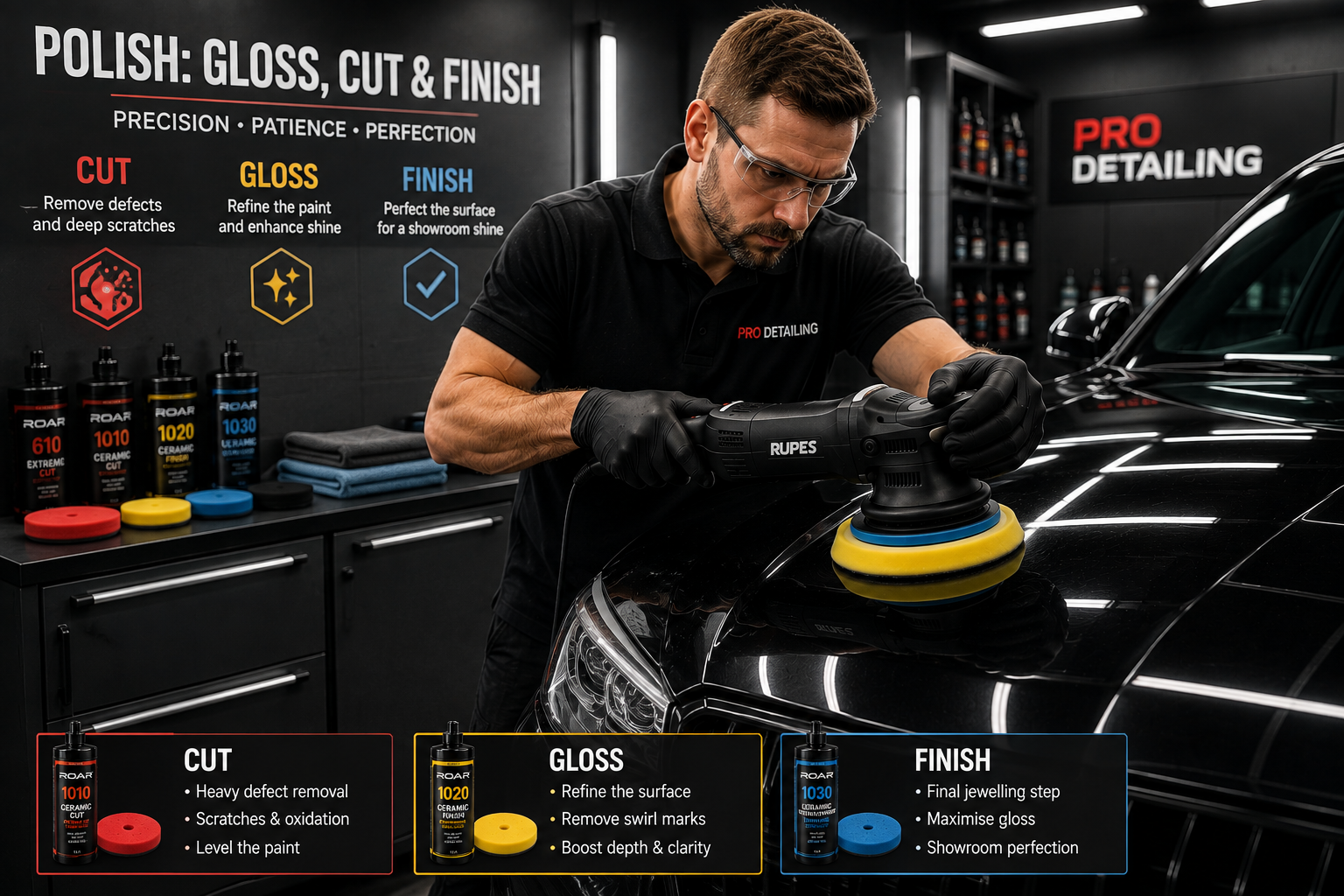
Choosing the wrong polishing product on black paint can leave you chasing holograms under workshop lights for hours. But here’s what most people don’t realize: the biggest mistake isn’t picking the wrong brand, it’s misunderstanding whether your job needs one stage or two.
Key Takeaways
- ROAR 1020 Ceramic Finish is a dedicated, silicone-free finishing compound built for controlled paint refinement – it does one job and does it exceptionally well.
- 3D One is a hybrid compound and polish that cuts, finishes, and reduces the need for follow-up steps, making it a strong choice when efficiency matters more than absolute correction depth.
- For dark paint, holograms, or show-quality results, separating your correction and finishing stages gives you far greater control over the final optical clarity.
- Neither product is a substitute for a dedicated cutting compound when paint defects are severe – knowing when to reach for something heavier is as important as knowing which finishing product to use.
- Understanding where each product sits in a correction sequence is what separates a professional result from a good one – something explored in detail below.
Choosing between a dedicated finishing compound and an all-in-one hybrid product is one of those decisions that looks simple until you’re standing under workshop LEDs on a black bonnet, chasing holograms. The product in your hand matters – but so does understanding what it was actually designed to do.
One Stage or Two? The Question That Decides Your Product
The most important question before reaching for any compound has nothing to do with brand marketing. It’s how many polishing stages the job actually needs.
A vehicle fresh off a respray with sanding marks and compounding haze needs a controlled, multi-stage approach. A daily driver with fine washing swirls and dull protection might respond perfectly well to a single hybrid product that corrects and finishes in one pass. These are fundamentally different jobs, and treating them the same way is where results go wrong.
That’s the real difference between ROAR 1020 Ceramic Finish and 3D One Hybrid Compound & Polish. One is built for refinement as a dedicated stage. The other is built to compress multiple stages into one. Neither approach is inherently better – they solve different problems. IPS Paint stocks both product types and regularly provides technical guidance on ipspaint.shop to help professionals match the right product to the right job.
What Each Product Actually Does
ROAR 1020: Refinement Without Compromise
ROAR 1020 Ceramic Finish is a professional finishing compound designed to permanently remove swirl marks, polishing haze, and fine surface defects, leaving behind a refined, high-clarity finish. It works across all paint systems, including modern scratch-resistant and UHS clear coats, and carries a silicone-free, body shop safe formulation.
The “Ceramic” in its name refers to the ceramic abrasive technology within the compound – not a ceramic protective coating. ROAR 1020 applies no protection layer. Its entire function is correction and refinement, which is precisely what gives it its edge in professional environments where each stage of the process is kept deliberately separate.
3D One: Cut and Finish in a Single Bottle
3D One takes a very different approach. It uses proprietary nano ceramic alumina abrasive technology to cut like a compound and finish like a fine-cut polish, all from a single product. Its aggressiveness is adjustable – swap the pad, change the result. A medium foam pad increases cut; a softer finishing pad backs it off.
3D One uses a no-filler formula, meaning the results you see after polishing reflect genuine correction rather than a temporary visual improvement masking the underlying defect. A separate sealant or coating step is still required for lasting protection, but the product delivers real, measurable improvement to the paint surface in fewer stages.
Correction Ability: How Do They Compare?
Where ROAR 1020 Has the Edge
Because ROAR 1020 focuses entirely on paint refinement, it performs with greater precision during a dedicated finishing stage. After a heavier cutting compound has addressed deeper defects, ROAR 1020 works through residual polishing marks and haze without any competing objectives. The abrasive system is calibrated specifically for this role – there’s no attempt to leave protection, no filler chemistry to manage. Just controlled refinement of the clear coat.
This matters particularly in body shop environments. Freshly refinished panels often carry sanding marks, compounding haze, or buffer trails that need removing cleanly before the vehicle leaves the workshop. A dedicated finishing compound fits neatly into that workflow in a way a hybrid product cannot quite replicate.
What 3D One Can Realistically Remove
3D One handles moderate to heavy surface imperfections – light scratches, oxidation, swirl marks, and general surface dullness. On a vehicle that doesn’t require aggressive pre-compounding, 3D One can take the paint from defective to refined in a single machine polishing stage. That’s a genuine capability, not a marketing claim.
The limitation appears when paint defects are significant, or when the target finish demands maximum optical clarity. In those scenarios, 3D One’s dual-purpose nature becomes less of an advantage and more of a constraint – it’s doing two jobs simultaneously, where ROAR 1020 is doing one.
Dark Paint, Holograms, and Optical Clarity
Black and dark metallic paints are unforgiving. What registers as a slight haze on silver becomes a glaring set of holograms and swirl patterns on a dark bonnet under direct sunlight or workshop lighting. This is where the argument for dedicated finishing stages becomes most compelling.
A two-stage approach – correct, then refine – gives the technician full control over each pass. After the correction work is done, ROAR 1020 can concentrate entirely on eliminating micro-marring and residual polishing marks without the process being compromised by any other chemistry. The result is a cleaner, sharper reflection with greater depth of gloss.
3D One can deliver impressive results on dark paint, particularly where defects are genuinely light. For a show-quality, hologram-free finish on a dark colour, separating the finishing stage is the more reliable path. Optical clarity achieved through refinement is harder to replicate in one pass.
Body Shop vs. Detailing Bay: Different Priorities
Why Body Shops Need Silicone-Free Refinement
In a body shop, silicone contamination is a production problem. Silicone residue in a paint environment causes fisheye defects in subsequent coats and can compromise adhesion. ROAR 1020’s silicone-free, body shop safe formulation is a deliberate design choice for exactly this reason.
Body shop technicians are also typically working to a defined correction sequence: cut, refine, and then apply protection separately if required. ROAR 1020 fits that workflow cleanly. It handles the finishing stage with precision and leaves the protection decision entirely to the technician – which is exactly where that decision should sit in a professional refinishing environment.
Where 3D One Wins on Efficiency
In a detailing bay, the calculus shifts. Labour time is a real commercial consideration, and not every vehicle on the ramp needs a full multi-stage correction. A car with light washing swirls, faded protection, and generally healthy paint is a strong candidate for a one-step approach.
3D One handles that scenario well. A professional detailer running an enhancement package can machine polish the entire vehicle, address the minor defects, and finish the surface in a single stage – then follow up with a standalone ceramic coating or sealant if the customer has requested long-term protection. That’s a meaningful time saving on the right job.
As a practical example, 3D One is well suited to one-step correction work on classic vehicles operating under tight budget and time constraints – the kind of job where an all-in-one product earns its place in the kit.
When Neither Product Is Enough
Neither ROAR 1020 nor 3D One is the right starting point for severely defective paint. Deep scratches, heavy oxidation, sanding marks, and substantial swirl damage require a dedicated cutting compound before any finishing or hybrid product enters the process.
Within the ROAR range, heavier correction work falls to ROAR 1010 Ceramic Cut before ROAR 1020 handles the finishing stage. Attempting to skip that sequence to save time rarely produces the result a professional would put their name to. Always assess the paint condition first, perform a test section, and work with the least aggressive combination capable of achieving the required result.
For True Correction, Separate Your Stages – ROAR 1020 Is the Finishing Standard
The choice between ROAR 1020 and 3D One is about which philosophy matches the job in front of you.
ROAR 1020 is the right tool when refinement is the priority: body shop work, multi-stage correction on dark paint, hologram removal, or any situation where the finishing stage needs to operate without compromise. Its silicone-free formula, dedicated abrasive system, and compatibility with all modern paint systems make it a dependable professional standard for that specific role.
3D One is the right tool when efficiency is the priority: lightly defective paint, time-pressured enhancement details, or one-step services where the customer needs genuine improvement without the cost of a full multi-stage correction. Its no-filler formula means results are honest, and its pad-adjustable aggressiveness gives real flexibility on the day.
The professionals who get the best results from both products are the ones who understand what each is designed to do – and resist the temptation to ask either one to do a job it wasn’t built for.
For a full range of professional polishing compounds, finishing products, and technical support, visit IPS Paint – specialist suppliers to the automotive refinishing and detailing trade.