
Correction Ability vs. Protection Convenience: ROAR 1020 vs. Griot’s
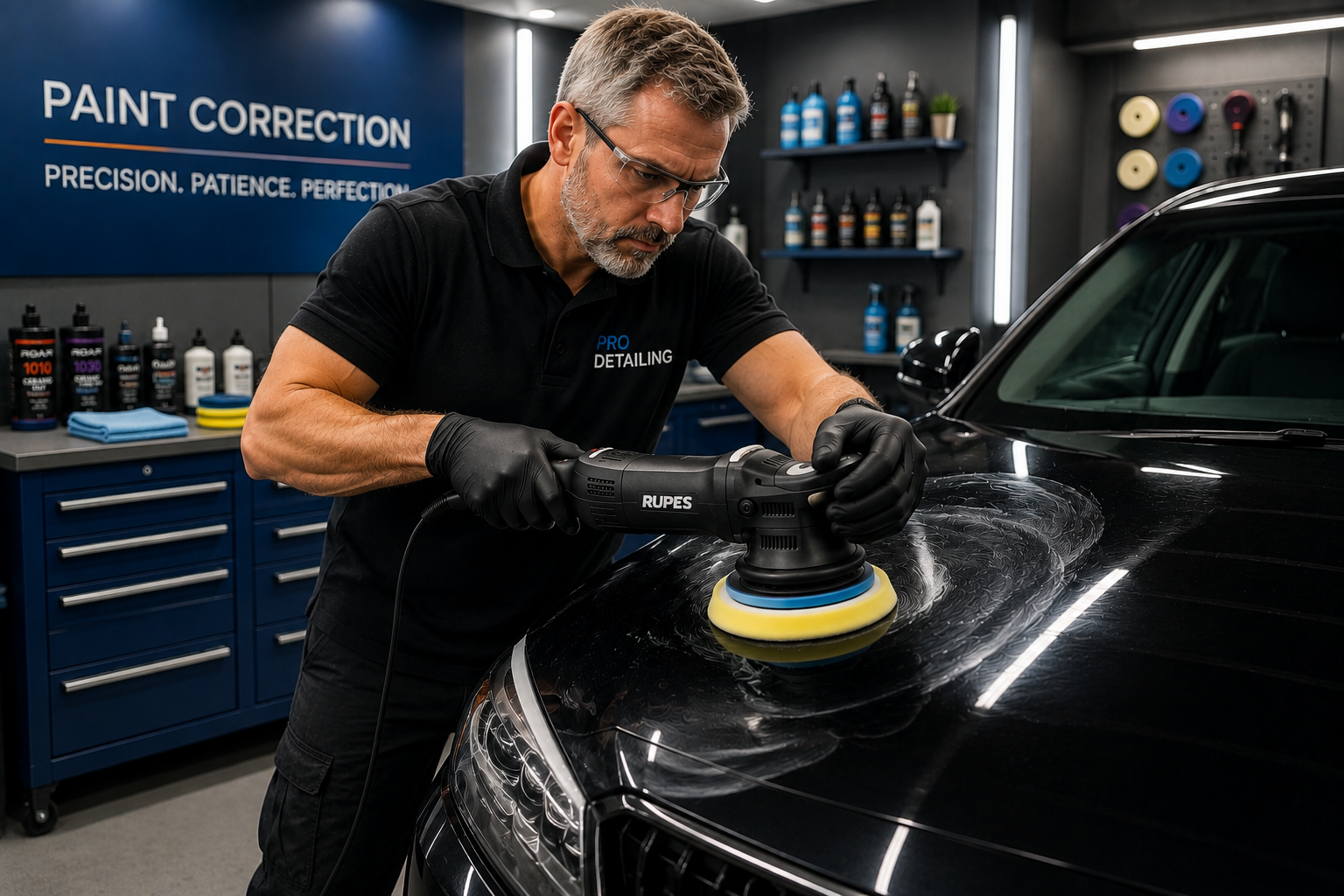
You’d assume an all-in-one polish with ceramic protection can’t match a dedicated finishing compound for swirl removal. But the real difference only becomes obvious under one specific condition: when you’re working with black paint. Here’s why that matters.
Key Takeaways
- ROAR 1020 Ceramic Finish is a dedicated finishing compound built for professional paint correction – it removes swirl marks, haze, and polishing marks with greater precision than a hybrid product.
- Griot’s Garage BOSS Ceramic All-in-One combines sub-micron abrasive correction with SiO2 ceramic protection in a single pass, making it a genuinely efficient option for lightly swirled paint.
- Neither product is designed for severe defects – deep scratches, heavy oxidation, and sanding marks require a dedicated cutting compound before either product enters the process.
- The right product depends entirely on paint condition and workflow priority: maximum correction or maximum efficiency.
- Dark paint and high-stakes finishes reveal the clearest difference between the two – and that distinction is worth reading closely.
The Decision That Changes Your Workflow
Every job starts with the same question: what does this paint actually need? The answer determines not just which product goes on the machine, but how many stages are involved, how long the job takes, and what the customer walks away with.
That tension sits at the centre of this comparison. ROAR 1020 Ceramic Finish approaches paint correction as a dedicated finishing stage – its entire purpose is to refine the surface. Griot’s Garage BOSS Ceramic All-in-One takes a different approach, combining light defect removal with SiO2 ceramic protection in a single operation. Both are legitimate professional tools. They just answer different questions.
IPS Paint supplies both products across the UK, and their breakdown of the ROAR polishing system – available at ipspaint.co.uk – gives useful context on where ROAR 1020 sits within a structured correction workflow. Understanding that positioning makes the comparison considerably clearer.
What Each Product Actually Does
ROAR 1020: A Finishing Compound Built for Swirl Removal and Showroom Gloss
ROAR 1020 Ceramic Finish is a Stage 2 finishing compound within the ROAR professional polishing system. It uses ultra-fine abrasives to remove fine scratches, holograms, and polishing marks left behind after a heavier correction stage, refining the surface so that light reflects cleanly and consistently from the clear coat.
The word “Ceramic” in the name does not indicate a protective coating. ROAR 1020 is formulated for paint refinement, particularly on modern paint systems including HS, UHS, and scratch-resistant (SR) clear coats. The silicone-free formulation matters in body shop environments where panel preparation is involved.
Its role in a professional workflow looks like this:
- Stage 1: Heavy cutting compound (e.g., ROAR 1010) removes deep defects
- Stage 2: ROAR 1020 refines the finish and removes polishing marks
- Stage 3 (optional): ROAR 1030 ultra-fine compound for mirror-level clarity on dark paint
- Protection: Applied separately based on the job specification
Each stage does one job. That precision is intentional.
Griot’s Garage BOSS Ceramic All-in-One: Sub-Micron Correction with Up to a Year of Ceramic Protection
Griot’s Garage BOSS Ceramic All-in-One (#10898) is the brand’s pro-grade multifunctional product. It uses defect-targeting sub-micron abrasives alongside an SiO2 protection system, so a single machine-polishing stage simultaneously improves the paint and leaves hydrophobic, UV-resistant ceramic protection behind.
Griot’s positions it within their correction scale closer to the finishing and protection end – between dedicated correction polishes and non-abrasive waxes. For vehicles with fine washing swirls, mild surface dullness, and intact clear coat, it can achieve a strong transformation in noticeably less time than a multi-stage process. Pad selection allows some adjustment of its corrective behaviour, and the product is optimised for use with a long-throw orbital polisher.
The workflow it enables is simpler by design:
- One stage: Light correction, gloss enhancement, and ceramic protection applied simultaneously
That simplicity has real commercial value – but it comes with limits.
Which Has More Corrective Power?
Where ROAR 1020 Pulls Ahead
ROAR 1020 wins on corrective focus. Because the abrasive formulation does not simultaneously deposit a protective layer, it can concentrate entirely on refining the clear coat. For a body shop dealing with freshly compounded panels, or a detailer chasing out fine holograms and micro-marring under workshop LEDs, that dedicated approach produces more controlled, predictable results.
It also fits cleanly into a multi-stage system. If the paint needs heavier cutting first, a dedicated compound handles that. ROAR 1020 then refines the result. Protection is chosen separately. Each product performs one clearly defined job, giving the technician meaningful control over the outcome at every stage.
Where Griot’s Holds Its Own
Griot’s BOSS Ceramic All-in-One offers genuine correction capability – fine swirl marks, light washing scratches, and mild surface haze are well within its range. The limit is severity. All-in-one products generally carry less aggressive cut than dedicated polishes, and the Griot’s range reflects this honestly: BOSS Fast Correcting Cream handles severe defects, BOSS Correcting Cream addresses moderate-to-heavy damage, and BOSS Perfecting Cream targets fine swirls specifically. BOSS Ceramic All-in-One sits further towards the protection end of that spectrum. Treating it as a heavy compound will produce disappointing results.
Dark Paint and High-Stakes Finishes
Black and deep-coloured paint is where the gap between the two products becomes most visible. Holograms, micro-marring, and residual swirls that barely register on silver or grey paint become stark and obvious on a black bonnet under direct sunlight or LED workshop lighting.
For those finishes, a dedicated finishing stage gives the technician full attention on surface refinement before any protection is introduced. ROAR 1020 – and particularly ROAR 1030 for ultra-fine final refinement – is specifically recommended for darker colours within the ROAR system. When the margin for optical error is smallest, separating correction from protection produces the cleanest result.
Griot’s BOSS Ceramic All-in-One can deliver an impressive outcome on dark paint where defects are genuinely minor. The objective differs, though – achieving a strong combined result efficiently, rather than extracting every last percentage point of optical clarity from the finishing stage.
Multi-Stage vs. One-Step: The Labour Argument
The Body Shop Case for ROAR 1020
Body shops are not typically looking for an all-in-one solution. The work involves freshly painted panels, sanding marks, controlled multi-stage correction, and surface preparation for subsequent coatings. Silicone contamination in that environment is a genuine problem, and ROAR 1020’s silicone-free formulation addresses that directly.
Workflow structure matters equally. A refinish environment benefits from each product having a defined, singular role: cutting compounds cut, finishing compounds refine, and protection is applied separately when appropriate. ROAR 1020 fits that model without compromise.
The Detailer’s Case for Griot’s
For detailers offering enhancement packages – where the paint is in reasonable shape and the customer wants a noticeable improvement with ceramic protection included – Griot’s BOSS Ceramic All-in-One makes a strong commercial case. The labour saving from combining a polishing stage and a protection stage into one operation is real, and on vehicles that do not require heavy correction, the result can be excellent.
Professional detailing is a technical and commercial exercise. Labour time, service efficiency, and competitive pricing all factor in. An all-in-one product that performs reliably on lightly swirled paint, leaves a year of SiO2 protection, and reduces total chair time by one stage carries genuine value – particularly for high-volume detailing operations.
When Neither Product Is Enough
Both ROAR 1020 and Griot’s BOSS Ceramic All-in-One sit towards the finishing end of the correction spectrum. Deep scratches, substantial oxidation, heavy swirl marks from machine washing, and sanding marks from refinishing work require a dedicated cutting compound before either of these products is introduced.
Griot’s own guidance is clear: start with the least aggressive method capable of achieving the required correction, and always perform a test section before committing to the full vehicle. A test panel reveals whether the chosen combination of machine, pad, and liquid is actually removing the defect – or simply making it temporarily less visible through product fill. Paint hardness also varies considerably between manufacturers and paint systems, so testing remains a non-negotiable step in achieving consistent professional results.
Match the Product to the Paint Condition
A useful way to approach the decision:
- Previously compounded panel with fine holograms or polishing haze: ROAR 1020 as a dedicated finishing stage
- Daily driver with fine washing swirls and minimal protection remaining: Griot’s BOSS Ceramic All-in-One for an efficient one-step enhancement
- Dark paint where optical clarity is the priority: ROAR 1020, or ROAR 1030 for ultra-fine final refinement
- Deep scratches, heavy oxidation, or sanding marks: Neither – begin with a dedicated cutting compound
- High-volume detailing, enhancement packages, time-sensitive jobs: Griot’s BOSS Ceramic All-in-One where paint condition allows
Pad and machine selection matters too. A firmer pad increases corrective ability; a softer finishing pad reduces cut and prioritises gloss. Neither product operates in isolation – the full combination of liquid, pad, machine, and technique determines the actual result on the panel.
ROAR 1020 for Correction. Griot’s for Efficiency. Choose Accordingly.
These two products represent genuinely different philosophies. ROAR 1020 asks how well the paint can be refined. Griot’s BOSS Ceramic All-in-One asks how much improvement and protection can be achieved efficiently in one operation. Both are valid questions – asked in different workshops, on different vehicles, for different customers.
For dedicated professional correction, particularly in body shop environments or on dark, high-scrutiny finishes, ROAR 1020’s singular focus on paint refinement gives it a clear advantage. For detailers working enhancement packages on vehicles in reasonable condition, Griot’s ability to simultaneously correct, refine, and protect in one pass makes it a compelling tool in the right situation.
The paint condition determines the answer – not a preference for one brand over another.
For a full range of professional-grade polishing and paint correction products, IPS Paint supplies automotive refinishing professionals across the UK.